Tuesday, May 18, 2010

Evergrn- Cheap, but will it get cheaper?

Results Update

Evergrn has just announced its results for QE31/3/2010. Its net profit jumped by 6-fold y-o-y but declined by 20.4% q-o-q to RM33.1 million. The drop in net profit was due to higher tax provision in the current quarter as one of the companies in the Group no longer enjoys continuous tax incentive unlike the previous quarter which had a tax write back instead of tax provision. Pre-tax profit, which may be a better indication of its operational performance, increased by more than 12-fold y-o-y or 8.1% q-o-q to RM37.0 million. Turnover increased by 54% y-o-y or 6.5% q-o-q to RM239 million.


Table 1: Evergrn's last 8 quarterly results


Chart 1: Evergrn's 21 quarterly results

Valuation

Evergrn (closed at RM1.49 yesterday) is now trading at a PER of 6.6 times (based on last 4 quarters' EPS of 22.6 sen). At this multiple, Evergrn appears very attractive. However, Evergrn had traded at such lower PER multiple before but the share price continued to decline as the earning rolled over. This was observed in August 2007 & February 2008 where the PER was only at 5.6-5.7 times. The decline in its earning in 2008 was partly due to competitive pressure from overcapacity as well as the global economic slowdown due to the US financial crisis. Go here & here.

Technical Outlook

We can see Evergrn has just broken below its uptrend line, based on the daily chart plotted on log scale (Chart 2). From the weekly chart (Chart 3), we can see that Evergrn is now resting on its 30-week SMA line (at RM1.48-50). In 2007, the break below the 30-week SMA line was followed by a sharp selloff (in August 2007) & a reversal (in November 2007).


Chart 2: Evergrn's daily chart (log scale) as at May 17, 2010 (Source: Tradesignum)


Chart 3: Evergrn's weekly chart (linear scale) as at May 17, 2010 (Source: Tradesignum)

Conclusion

Despite the good financial performance & attractive valuation, Evergrn may deserve a HOLD rating due to its mildly negative technical reading. However, if the share price were to drop below RM1.50 convincingly, we can expect further downside for Evergrn.

Airport- time for some profit-taking

Results Update

Airport has just announced its results for QE31/3/2010. Its net profit dropped by 48% q-o-q or 21% y-o-y to RM72.5 million while turnover increased by 11.9% y-o-y but declined by 8.4% q-o-q to RM436 million. The drop in net profit was attributable to the following reasons:
1. Adoption of FRS139 which resulted in higher share of losses in an associate company, whereby the concession payable by the said company is recognized at fair value & subsequently at amortized cost. Gains & losses arising from changes in the fair value were recognized in the income statement. Stripping off the impact from the adoption of FRS139, Airport's pre-tax profit would increase by 12% y-o-y to RM139.9 million.

2. The pre-tax profit for QE31/3/2009 was positively impact by reversal of lease rental payable to the Government of RM52.0 million as well as a backdated user fee for FY2008 of RM45.8 million subsequent to the signing of the Operating Agreements.

If we factored in these reasons, we can see that Airport's financial performance remain satisfactory.


Table 1: Airport's last 8 quarterly results


Chart 1: Airport's 16 quarterly results

Valuation

Airport (closed at RM4.98 yesterday) is now trading at a PER of 15.6 times (based on last 4 quarters' EPS of 32 sen). At this multiple, Airport is trading very near its fair value.

Technical Outlook

Airport has a very strong rally in the past 17 months, rising from a low of RM2.00 in January 2009 to the present level of about RM5.00. Airport share price appears to be trapped within an ascending triangle pattern, with resistance at RM5.00. A break above the RM5.00 level would lead to a continuation of the prior uptrend. However a downside breakout below RM4.90 could lead to a bearish reversal.


Chart 2: Airport's daily chart as at May 17, 2010 (Source: Quickcharts)

Conclusion

After the recent strong rally, I believe some profit-taking for Airport may be a good idea.

Monday, May 17, 2010

PIIGS- dragging down the EURO

The hope engendered by the proposed EU & IMF plan to rescue Greece & other PIIGS nations has since faded. This is clearly reflected by the sharp plunge in the Euro (see Chart 1). The Euro may find good support at the horizontal line of 1.24-1.25 (the low recorded in October- November 2008 & March-April 2009). Conversely, the USD index has shot up (see Chart 2). It may test the highs of 88-90 recorded in October- November 2008 & March 2009.


Chart 1: EURO's daily chart as at May 14, 2010 (Source: Stockcharts.com)


Chart 2: USD's daily chart as at May 14, 2010 (Source: Stockcharts.com)

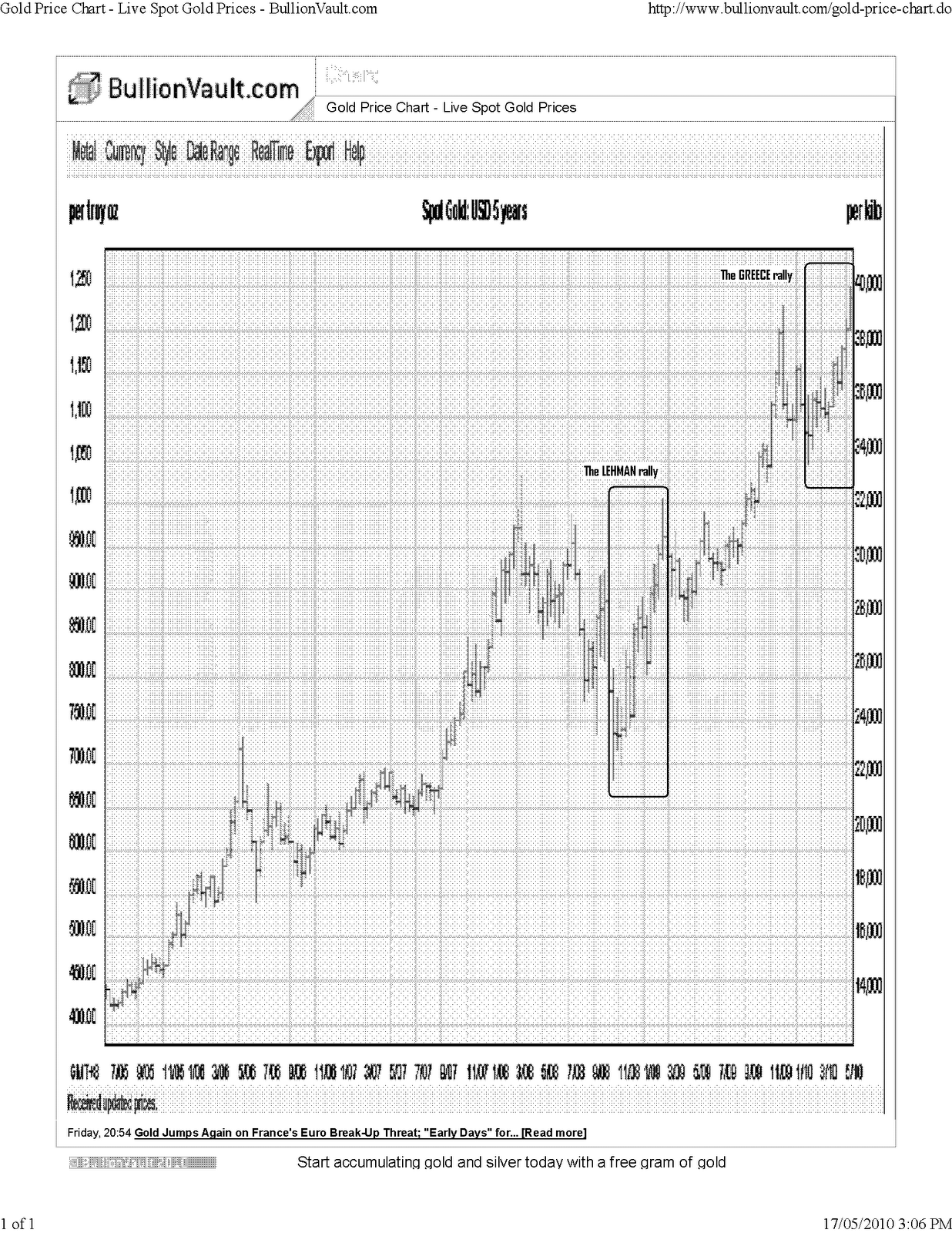
Another indicator of the flight to safety is the sharp rise in the price of gold. We have seen that in October 2008 to March 2009, and we are seeing that again since February this year (see Chart 3 below). Last week, gold price has surpassed the high of USD39000 per kg recorded in November 2009. Until a more workable or pragmatic solution is found to the problem of high government debts amongst developed nations in general and the PIIGS nations in particular, the financial markets will continue to be in bearish mode. For more on the problem of high debt among developed nation, go here. For more on the PIIGS nations' indebtedness, go here.


Chart 3: Gold's 5-year weekly chart as at May 14, 2010 (courtesy of Bullionvault.com)

Friday, May 14, 2010

Spritzr- uptrend to continue?

Background

Spritzer Bhd ('Spritzr') is involved in the manufacturing and distribution of natural mineral water, sparkling natural mineral water, distilled drinking water, carbonated fruit flavoured water, carbonated fruit flavour isotonic water, teas, toothbrushes, preforms and packaging bottles.

I posted on this stock in September last year, which was entitled "Spritzr- a not-so fizzy stock". Well, it is bubbling up now.

Recent Financial Results

For QE28/2/2010, Spritzr's net profit increased by 1.7% q-o-q or 32% y-o-y to RM3.2 million while its turnover increased by 10.0% q-o-q or 17% y-o-y to RM32.5 million.


Table 1: Spritzr's last 8 quarterly results


Chart 1: Spritzr's 15 quarterly results

Valuation

Spritzr (at RM1.15 as at 4.30pm today) is now trading at a PER of 13 times (based on last 4 quarters' EPS of 8.7 sen. Due to its strong growth over the past few quarters, Spritzr could easily trade at a PER of 15 times. At a PER of 15 times, Spritzr would command a fair value of RM1.30.

Technical Outlook

Spritzr broke above its recent high of RM1.05 (after a few attempts). With this breakout, Spritzr could continue with its prior uptrend.


Chart 2: Spritzr's daily chart as at May 14, 2010 (Source: Quickcharts)


Chart 3: Spritzr's monthly chart as at May 3, 2010 (Source: Tradesignum)

Conclusion

Based on good financial performance, reasonable valuation & further technical breakout, Spritzr could be a good trading BUY.

Sime- is it too big to be managed?

It is reported that Sime Darby Bhd has asked its president and group chief executive Datuk Ahmad Zubir Murshid to take a leave of absence prior to the expiry of his contract on Nov 26, 2010. The group also said it would take a hit of RM964mil in its second half earnings from losses from its energy division. For more, go here.

The RM964mil provisioning that will take place, is made up of losses of RM200mil from the Qatar Petroleum project, RM159mil from the Maersk Oil Qatar project, RM155mil from a project to construct vessels for use in the latter project and RM450mil from cost overruns in the Bakun project.

Looking at the daily chart below, we can see that a medium-term downtrend has formed over the past 6 months. This morning, the share price broke below 2 horizontal support levels at RM8.50 & RM8.30. After making a low of RM8.08, the stock rebounded to a high of RM8.41 at 9.52am. With the 50-day SMA line crossing below the 100-day & 200-day MA line, Sime is likely to drift lower. I would rate Sime a SELL INTO STRENGTH at the present price of RM8.35.


Chart: Sime's daily chart as at May 13, 2010 (Source: Tradesignum)

The current losses in Sime's energy division brings to mind the RM120mil losses in futures trading in its subsidiary, Golden Jomalina in FY2008 (here). The question that must be addressed is whether Sime Darby is too big to be well-managed.

Thursday, May 13, 2010

WTHorse trotting along

Results Update

WTHorse has just announced its results for QE31/3/2010. The first calender quarter is usually a quiet period due to the slow construction activities during the long lunar new year break. This is reflected in the q-o-q decline in turnover & net profit by 15% & 44%, respectively. However, its net profit increased by 40% y-o-y on the back of a 14%-increase in turnover.


Table 1: WTHorse's last 8 quarterly results


Chart 1: WTHorse's 19 quarterly results

Valuation

WTHorse (closed at RM1.54 yesterday) is trading at a PER of 5.5 times (based on last 4 quarters' EPS of 28 sen). At this multiple, WTHorse is deemed inexpensive. If we were to value it at a PER of 8 times, its fair value could be about RM2.24.

Technical Outlook

WTHorse broke above its long-term downtrend line at RM1.05 in January 2009. The 20-week SMA line (presently at RM1.46) is a good proxy for a medium-term uptrend line for the stock. Immediate resistance is at RM1.70 & then RM1.88-90.


Chart 2: WTHorse's weekly chart as at May 12, 2010 (Source: Quickcharts)

Conclusion

Based on good financial performance, attractive valuation & good technical outlook, WTHorse is still rated a HOLD.

Wednesday, May 12, 2010

Kurasia- rebounding off its uptrend line

Background

Kurnia Asia Bhd ('Kurasia') is a holding company which wholly owns Kurnia Insurans (Malaysia) Berhad - the largest general insurer in Malaysia.

Recent Financial results

Kurasia's financial performance has improved slowly over the past 6-7 quarters after taking a huge loss of RM303 million in Qe30/6/2008. That net loss was mainly due to a 23.4%-increase y-o-y in Claims Expenses from RM877 million for FY2007 to RM1.082 billion for FY2008; a 11.1%-increase y-o-y in Management Expenses from RM212 million for FY2007 to RM235 billion for FY2008; and, a 48.9%-drop y-o-y in Investment income from RM182 million for FY2007 to RM93 million for FY2008. It is hearty to note that the increased Claims Expenses was due to higher claims provision in compliance with more stringent reserving requirement under RBC framework.


Table 1: Kurasia's last 8 quarterly results


Table 2: Kurasia's Huge Loss of RM303 million in QE30/6/2008 explained


Chart 1: Kurasia's 8 quarterly results

Valuation

Kurasia (closed at RM0.56 today) is now trading at a PER of 7.6 times (based on last 4 quarters' EPS of 7.36 sen). At this PER multiple, Kurasia is deemed inexpensive.

Technical Outlook

From the chart below, we can see that Kurasia has recently tested in its medium-term uptrend line support at RM0.50. The strong rebound today (with gain of 4 sen) may indicate that this stock is likely to continue with its prior uptrend.


Chart 2: Kurasia's daily chart as at May 11, 2010 (Source: Tradesignum)

Conclusion

Based on steadier financial performance, undemanding valuation & good technical outlook, I believe Kurasia could be a good stock for medium-term investment.

KKB- rising on good results, Bonus Issue & Share Split

Results Update

For FYE31/3/2010, KKB's net profit increased by 59% q-o-q or 209% y-o-y to RM19.0 million while turnover increased by 9% q-o-q or 123% y-o-y to RM68 million (see Table 1 below). From Table 2, we can see that the improved performance was attributable to 223%-increase in turnover which resulted in a 290%-increase in the results of both the manufacturing & engineering divisions.


Table 1: KKB's last 8 quarterly results


Table 2: KKB's Segmental Results analysis


Chart 1: KKB's 11 quarterly results

Corporate Exercise

KKB will be implementing a 3-for-5 Bonus Issue plus 1-to-2 Share Split on May 24. A shareholder who has 5000 shares would end up with 16000 shares after this exercise.

Other Comments

In April 2008, Cahaya Mata Sarawak Bhd ('CMS') became a substantial shareholder of KKB when it acquired 20.05%-stake in KKB from the Chairman/Group MD, Dato Kho Kak Beng. With this tie-up, we can expect a steady flow of contract from CMS to KKB as Sarawak embarked on its ambitious program of industrial development.

Valuation

KKB (trading at RM6.40 as at 12.00 noon) has a trailing PER of 10.5 times [the last 4 quarters' EPS of 61 sen]. At this multiple, KKB is deemed inexpensive.

Technical Outlook

KKB has risen from a low of RM1.50 in early 2009 to a recent high of RM6.53. From Chart 2, we can see that KKB is approaching the all-time high of about RM7.30 recorded in 1996. Can it revisit that high? KKB may be forming an expanding triangle (or, some may see a broadening top), with resistance at RM7.00 (see Chart 3). So, it is possible that the developing rally today, which coincides with the announcement of the Bonus Issue plus Share Split yesterday, could potentially test the RM7.00 level (or, even beyond it).


Chart 2: KKB's weekly chart as at May 10, 2010 (Source: Tradesignum)


Chart 3: KKB's daily chart as at May 12, 2010_11.30am (Source: Tradesignum)

Conclusion

We have to weigh the strong financial performance & attractive valuation with the sharp rally in the share price. On balance, I would rate it good for a SELL ON STRENGTH as it approaches the RM7.00 level. However, its connection to CMS may ensure that the company would continue to do well and one may want to accumulate this stock on price weakness.

MSC hit by impairment provision

Results Update

MSC has just announced its results for QE31/3/2010. It reported a net loss of RM29.1 million due to impairment provision of RM48 million on investment, comprising RM41 million from the investment in BCD Resources NL and RM7 million for loans granted to a JV company, Guilin Hinwei Tin Co.

If the impairment provision is excluded, MSC would report a pre-tax profit of RM28 million as compared to a pre-tax profit of RM25 million for QE31/12/2009 or a pre-tax loss of RM9 million for QE31/3/2009.


Table: MSC's last 8 quarterly results


Chart 1: MSC's 17 quarterly results

Technical Outlook

MSC is still forming a base with short-term uptrend line support at RM3.20.


Chart 2: MSC's weekly chart as at May 10, 2010 (Source: Tradesignum)

Conclusion

Based on the improving operating results & better prices for commodities in general & tin in particular, I believe MSC could be a good stock for long-term investment.

Harta proposed a 1-for-2 Bonus Issue

Results Update

Harta has just announced its results for QE31/3/2010. Its net profit increased by 25% q-o-q or 50% y-o-y to RM46.4 million while turnover increased by 10% q-o-q or 31% y-o-y to RM163 million. It is worth noting that the pre-tax profit & net profit margin inched up to 34.6% & 28.4%, respectively.


Table: Harta's last 8 quarterly results


Chart 1: Harta's last 10 quarterly results

Other announcement

Harta has also announced a Bonus Issue of 1-for-2, which should be well received by retail investors. While not adding value to the stock, bonus issues- like share splits- would make the stock more affordable to retail investors as well as increasing liquidity & depth for the stock. The other rubber glove makers like Topglov & Supermx have also proposed Bonus Issue of 1-for-1 & 1-for-4, respectively.

Valuation

Based on Harta's closing price of RM7.85 yesterday, the stock is now trading at a trailing PER of 13.3 times (based on last 4 qaurters' EPS of 59 sen). This is lower than the PER multiple of 15.5 times currently enjoyed by Topglov (based on its closing price of RM12.26 & last 4 quarters' EPS of 79 sen). I think Harta should not trade at a 14%-discount to Topglov.

Technical Outlook

Harta is still in an uptrend, based on the daily chart below (plotted on log scale). However, bearish divergence in RSI is noted. At the same time, we can see -ve DMI has crossed above the +ve DMI. We will have to wait & see whether the good financial results & the proposed Bonus Issue would give the stock a sufficient boost that could rectify the stalled technical picture.


Chart 2: Harta's daily chart as at May 11, 2010 (Source: Tradesignum)

Conclusion

Based on continued strong financial performance & the proposed Bonus Issue, Harta is rated a HOLD.

Tuesday, May 11, 2010

Masterskill ('MEGB')- a true master or...

Masterskill is a new IPO which is due to be listed on the exchange on May 18. The IPO- Malaysia’s biggest initial public offering for 2010- raised RM771 million.

Masterskill is involved in the provision of medical nursing training services through Masterskill University College of Health Sciences, which is Malaysia's largest group of nursing colleges.

What I find amazing about Masterskill is its fantastic net profit margin. From Table 1 below, you will see that its net profit after tax is a whopping 35-36% of its revenue for FY2008 & FY2009. At the same periods, its pre-tax profit is about 39-41% of revenue.


Table: Masterskill's Financial Results for FY2007-2009

The extremely high profit margin is way above the profit margin of three of the education groups listed in Malaysia- HELP, SEG & Stamford College.


Table 2: The last 2 years' results for Masterskill, HELP, SEG & Stamford

There are two ways that this is possible, either Masterskill charges a higher fee than the other colleges or it has a lower level of expenses than the other colleges (eg. lower lecturers' pay, lower facilities expenses, etc). Why would the students pay more to study at Masterskill? Could it be that they can easily get employment in government hospitals? Or, is it because the students can have easy access to government loans to finance their study? Why would the students choose a college where the lecturers may not be the best (if you pay less, you would not attract the best) & the facilities are lacking? I still remember reading about the grouses of the medical students in one of the cheaper local colleges, which include the very limited number of cadavers for their study, only one for a class of 40. If you cut corner deep enough, you can save a lot of expenses & make a huge profit. Would you produce good nurses? Would the employers (private & government hospitals) accept such graduates?

We do not know what is the reason for Masterskill's exceptional high profit level. For all we know, the competitors are grossly incompetent and Masterskill is a truly exceptional company. However, I have been around long enough to know that such truly great companies are very rare indeed.

Haio tested its uptrend line

A few readers have asked whether Haio is a BUY during its recent correction. Let's use technical analysis to determine what would be a good entry level. Since this stock has moved from a low of less than RM1.50 in May last year (or RM0.30 in 2005) to a high of nearly RM5.00, the appropriate chart scale to use is log scale. Based on the daily chart (Chart 1), we can see that Haio tested its immediate uptrend line support is at RM3.80 on May 7, before rebounding. Haio continued to recover yesterday as well as early part of this morning. This recovery is fairly convincing. For those who like to accumulate this stock, you may do so now.


Chart 1: Haio's daily chart as at May 10, 2010 (Source: Tradesignum)

From the weekly chart (Chart 2), we can see that Haio's fantastic rise occurred after it has broken above its triangle ('ABC') at RM0.50 at the end of 2006. A long-term uptrend line ('SS') can be drawn, but a better guide would be the 20-week SMA line (which is equivalent to the 100-day SMA line). The 20-week SMA line provide support at RM4.05. The indicators reading is mildly negative, with bearish MACD cross-under; still positive RSI reading of 58; and potentially negative reading on ADX as the rising -ve DMI crossed the declining +ve DMI.


Chart 2: Haio's weekly chart as at May 10, 2010 (Source: Tradesignum)

For a more comprehensive look at Haio, go here.

Monday, May 10, 2010

Euro Leaders Agree To Huge €720 BILLION Bailout Fund for PIIGS

European leaders have agreed to provide a huge rescue package of €720 BILLION in an effort to tackle the debt crisis that has engulfed European countries such as Portugal, Ireland, Italy, Greece & Spain (commonly referred to as 'PIIGS').

The bailout basically consists of the following:

* A €60 billion bailout fund.
* Another €440 billion in the form of loans.
* Another €220 billion from the IMF.

While this package would calm the global financial markets, I doubt it would help the economy of the weaker PIIGS nations, such as Greece, to recover. Greece would improve its chances of recovery by leaving the EU and restructuring its mountain of debts. A hard currency like the Euro is a dead weight for a lightweight like Greece. And, without a significant haircut of its outstanding debts, the debt servicing would be too burdensome for Greece.

Based on the positive effect of this package, I believe the global financial markets would stage a quick rebound this week. Would the recovery be sufficient to rectify the damage done to an already overbought & overextended market? We will have to wait & see.

Friday, May 07, 2010

Topglov broke its long-term uptrend line

Topglov broke below its long term uptrend line at RM12.00 yesterday. That uptrend line stretches back to January 2009. In addition, we can see two other negative signs: the MACD entering into the negative territory (potentially a prelude to a sustained decline) and the 20-day SMA line cutting below the 50-day SMA line. We can also note that the RSI is beginning to enter into the 'oversold' territory, where a prolonged stay therein is a prelude for sustained decline. After a sharp fall this morning (to an intra-day low of RM11.18), Topglov has enjoyed a sustained rebound to touch RM11.96 as at 3.45pm.

So, we will wait & see whether the developing rebound can take Topglov back above the uptrend line support at RM12.00 & maybe to rectify the negative technical picture as painted by the indicators. Failing which, Topglov could have made a cyclical top & it could commence on its long-term downtrend shortly thereafter. In fact, a short-term downtrend has already started as seen by the presence of a lower 'low' & a lower 'high' (denoted as L1/L2 & H1/H2).


Chart: Topglov's daily chart as at May 6, 2010 (Source: Tradesignum)

If Topglov has made a top, then chances are that the other rubber glove makers could have made theirs or about to make theirs. After all, Topglov is the top dog in this industry.

Market Outlook as at May 7, 2010

FBM-KLCI hit a low of 1315.63 early this morning. It closed at 1324.91 at the end of the morning session. We can see from Chart 1 that FBM-KLCI has a good support at its 50-day SMA line. In the past one year, this SMA line has tested numerous times and the only occasion when it was violated was in late January this year. I have highlighted that technical breakout below. The 50-day SMA line support is now at 1322.


Chart 1: FBM-KLCI's daily chart as at May 6, 2010 (Source: Tradesignum)

If we looked back to bull rally of 2006-7, we can also see how strong is the support of the 10-week SMA line (which is equivalent to the 50-day SMA line). On the 3 occasions when it was violated (denoted as X, Y & Z), the market suffered sharp selldown. See Chart 2 below.


Chart 2: FBM-KLCI's weekly chart as at May 6, 2010 (Source: Tradesignum)

From the above, it is important that the FBM-KLCI stays above the 50-day SMA line or 10-week SMA line at 1322-24. A break below this level could easily send the market to the psychological 1300 level (which almost coinciding with the support of 100-day SMA line, presently at 1297) and even the 200-day SMA line, presently at 1256.

Thursday, May 06, 2010

Faber- now you see it, now you don't

Results Update

Faber has just announced its results for QE28/2/2010 and it is a HUGE DISAPPOINTMENT! Even though, the results was an improvement over the results of the previous corresponding quarter, it was substantially lower than the immediate preceding quarter, with net profit lower by 66% to RM14.4 million & turnover lower by 39%.


Table 1: Faber's last 10 quarterly results

Now, we learned that the big jump in the immediate preceding quarter, QE30/11/2009 was attributable to the higher revenue from Integrated Facilities Management ('IFM') Concession which was mainly due to one-off revenue received from hospital for the claim for linen loss. In addition, it has completed a IFM maintenance contract secured earlier (see Table 2 for Note 20). In the absence of these two factors, Faber's top-line & bottom-line dropped in QE28/2/2010. None of these exceptional items were explained in the Notes accompanying the results for QE30/11/2009 (see Table 3 for Note 21). In fact, if one were to read Note 22 for QE30/11/2009, you would get a very bullish impression of the future prospect of Faber because the note insinuated the improvement was sustainable due to higher revenue from the new business in UAE & higher bed occupancy plus additional new facilities in government's hospital (see Table 3 for Note 22).

Incomplete disclosure of this nature reflects badly on the professionalism of Faber's management.


Table 2: Faber's q-o-q changes for QE28/2/2010 explained


Table 3: Faber's q-o-q changes for QE30/11/2009 "explained"


Table 4: Faber's q-o-q changes for QE30/11/2009- further explanation?


Chart 1: Faber's 13 quarterly results

Valuation

Assuming that Faber's results for QE28/2/2010 can be maintained for the next 3 quarters, its full-year EPS would be about 16 sen. Based on its closing price of RM2.26 yesterday, Faber is trading at a forward PER of 14 times. The stock is fully valued. Faber should trade at a PER of no more than 13 times, a discount of at least 15% to market- due to its poor professionalism.

Technical Outlook

The stock may find support at the 10-week or 20-week SMA lines at RM2.18 or RM1.97. If these support failed, it could test the strong horizontal support at RM1.75.


Chart 2: Faber's weekly chart as at May 5, 2010 (Source: Quickcharts)

Conclusion

Based on the above, Faber is rated a SELL on strength.

Tuesday, May 04, 2010

Time to take profit (Part 2)

The following three stocks have performed very well due to the discovery or re-discovery of hidden value in the company by investors. Let's take a quick look at them from a technical perspective.

Jerneh

Jerneh has risen from a low of RM0.80 to the RM3.00 over the past one year. The big jump happened after the company announced that it was negotiating to dispose off its insurance subsidiary. The stock is now trading at the high recorded in 2000. I have commented before that if Jerneh managed to dispose of its 80%-stake in Jerneh Insurance Bhd (JIB) for 1.5 times net asset, it would book in an extraordinary gain of RM94 million. In addition, it would have converted a Non-current Assets to cash, which amount to RM283 million. Does an extraordinary gain of about RM0.52 per share (arrived at by dividing the extraordinary gain of RM94 million by outstanding shares of 180.7 million) justify a rise in share price of about RM1.50-1.80 since October 2009? If the traders & investors' enthusiasm for the stock were to slacken, what do you think of the chances of the stock breaking above the strong resistance of RM3.00? Conversely, would you think it is more likely that they would choose to play it safe & cash in their chips? For my initial post & follow-up post, go here & here.


Chart 1: Jerneh's monthly chart as at April 30, 2010 (Source: Tradesignum)

KSeng

We have noted that the Edge newsletter had published an article entitled "Time for Keck Seng's value to emerge" in March this year. This article highlighted KSeng's revised NAV per share of RM17.10 provided the company revalued its entire landbank, properties & equity investment. Despite being a rehashed of an old story, the market took to this piece of 'analysis' with gusto. The share price rose RM2.00 to RM6.00- an all-time high. Unless the shareholders/management intend to quickly realize the hidden value of the company's assets, either by an attractive privatization offer or to dispose or develop the land on a fast track basis, investors' enthusiasm for the stock would slowly wane & with it, the high price commanded by the stock. Maybe something similar happened in 1996, the last time this stock made its then all-time high. Who knows!

For my earlier posts on this stock, go here, here & here.


Chart 2: KSeng's monthly chart as at April 30, 2010 (Source: Tradesignum)

Conclusion

Based on the above, it may be advisable to take some profit on these two stocks.

Monday, May 03, 2010

Time to take profit (Part 1)

These days, I find it very hard to suggest any stock ideas because so many stocks have gone up so much. What's disconcerting & a bit shocking is that some of my readers & clients are asking about my old stock ideas which had risen spectacularly. I would list down some of them but I am sure some of you may say "No, ABC has a low forward PER of xx times based on EPS of xx sen, which would increase by xx% going forward." Some stocks may have other story lines, like an anticipated privatization or an impending business spin-off. For the latter category of stocks, you have to ask the tough questions like how likely is the privatization going through (and at what price) and for business spin-off, what would happen to the sale proceed (or, what new business would be acquired with this proceed). For the former category, you must ask questions like is the earning sustainable (or, is it cyclical). And, for both categories, you just consider how much of this story has been factored into the price.

The first two charts (KKB & Daiboci) show the stocks have risen to match the high recorded in 1996- the high recorded just before the Asian Financial Crisis. Check out my earlier post on KKB (here). I did not post on Daiboci, except to call a SELL on the stock (here).

KKB

KKB (closed at RM5.93 yesterday) is now trading at a trailing PER of 13 times (based on EPS of 45 sen for FY2009). It has benefited from sharply higher top-line & bottom-line in the past two quarters. Can KKB maintain these performance going forward? See Table 1 below.


Table 1: KKB's last 8 quarterly results


Chart 1: KKB's monthly chart as at April 30, 2010 (Source: Tradesignum)

Daiboci

Daiboci (closed at RM3.21 yesterday) grew its turnover by 9% q-o-q in QE31/3/2010 but suffered a 17%-drop in net profit. It trades at a trailing PER of 11 times (based on last 4 quarters' EPS of 30 sen). Why did Daiboci fail to grow its top-line for so long, until the last quarter (QE31/3/2010)? Even the higher turnover for QE31/3/2010 was accompanied by a lower net profit.


Table 2: Daiboci's last 8 quarterly results


Chart 2: Daiboci's monthly chart as at April 30, 2010 (Source: Tradesignum)

Conclusion

Based on the extremely sharp price run-up for these two stocks, I think it is best to take profit now.