Monday, September 11, 2006

Carotec may show the way forward for the Biofuel play

Carotec is involved in the production of phyto-nutrients & oleo-chemicals. The former consists mainly of food supplements such as Vitamins while the latter will be dominated by the production of Biofuel.

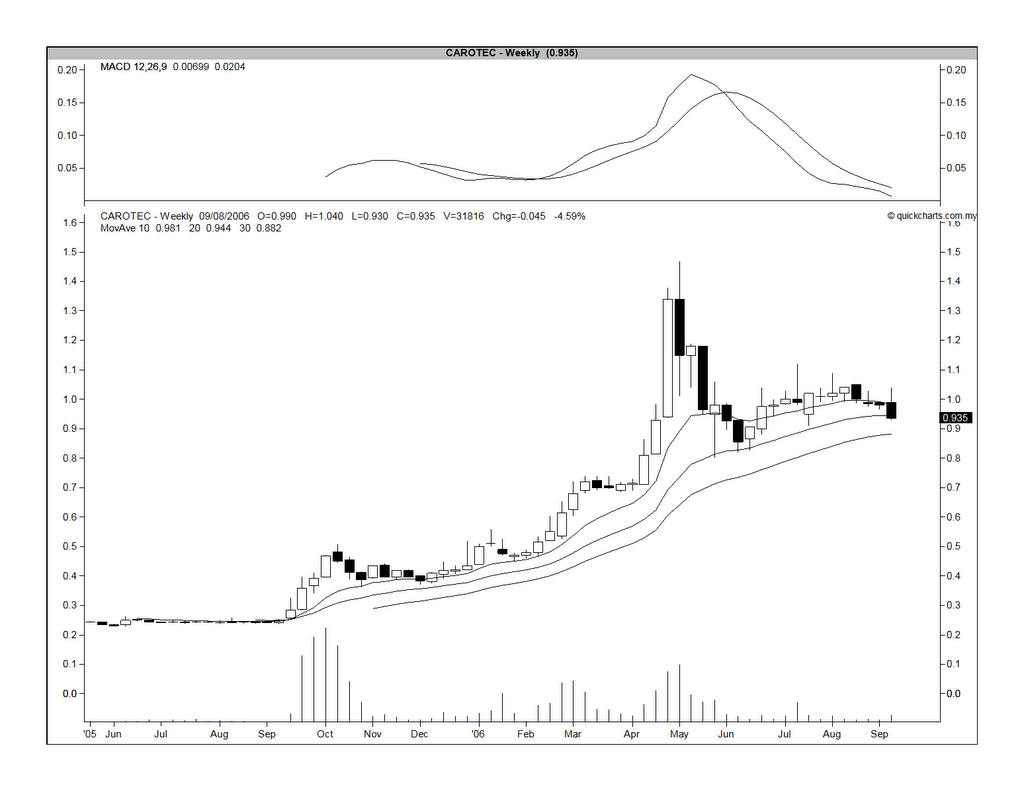
One can say that Carotec was the first company for which the share price has gained substantially due to its involvement in the Biofuel sector, thus benefitting from the recent Biofuel theme play (see Chart 1 below).


Chart 1: Carotec's weekly chart as at Sep 8

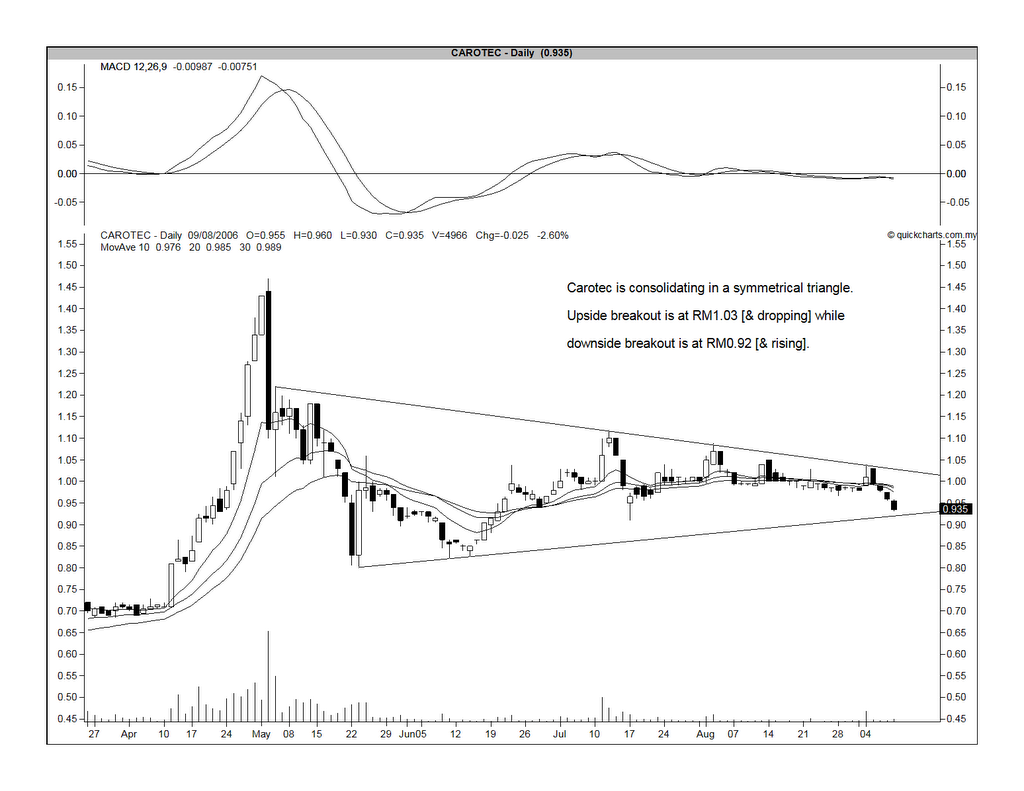
The share price has been consolidating since the May & June selldown. From Chart 2 below, you will notice that the consolidation will only come to an end once the price has broken out of the symmetrical triangle pattern that the share is currently trading in. This morning, the share has broken out of that pattern on the downside [breakout level: RM0.92] when it dropped to a low of RM0.865 at 9.50 a.m. At the time of writing this post [at 11.45 a.m.], the price is at RM0.88. Unless a recovery happens swiftly & the price can recover back to the RM0.92 level, the technicians would view this as a SELL signal.


Chart 2: Carotec's daily chart as at Sep 8

Update made on September 13

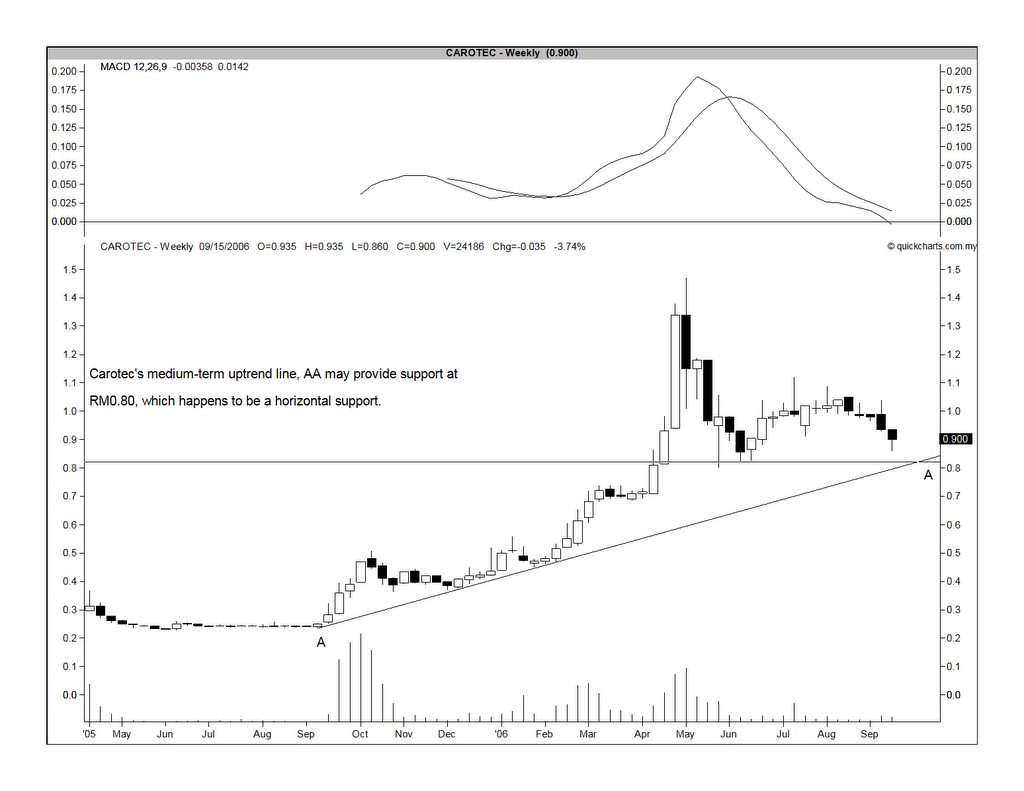
After further study of Carotec's weekly chart, I would revise my assessment of the stock's outlook slightly. The short-term outlook remained unchanged i.e. bearish. Medium-term outlook is still good as its uptrend is still in tact. Only when the share price has broken below RM0.80/82 level would the uptrend line be broken (see Chart 3 below).


Chart 3: Carotec's weekly chart as at Sep 13

Saturday, September 09, 2006

Linkfest

The linkfest for the weekend...

1. Last week, we’ve learned about the discovery of a vast oil deposit roughly four miles beneath the ocean floor in Gulf of Mexico. The discovery has coincided with the on-going correction in the price of crude oil. Some analysts had questioned the impact the discovery on the market sentiment. Roger Conrad of The Utility Forecaster was noted in The Stock Advisors as saying "... even if the deepwater Gulf does ultimately become the North Sea of this generation - which will only be possible if production costs come off sharply and reserves wind up exceeding even today’s most optimistic projections - we still have years to wait before any of its output comes to market. Read more about here.

2. Ticker Sense & Market Talk with Piranha had noted that crude oil had closed below its 200-day moving average on Sep 7. While technicians consider this a bearish sign, they had shown that such prior occurrences, at least going back to 2002, had turned out to be buying opportunity. Go here & here.

3. The best offense is a good defense, especially in the event of an economic slowdown. Here is five ways to recession-proof your portfolio.

4. What do George Lindsay, Terry Laundry & Tom Henderson have in common? They all have their creative way of analyzing the market. Brett Steenbarger has highlighted the work of these 3 persons in an article entitled “3 creative approaches to market analysis

5. Recently, I have turned a bit bearish on the Malaysian stock market because I believe it was about to do a short-term correction. But, there are a lot of people out there who are not only not bullish on our stock market; some are downright bearish on the market. My contrarian instincts always tell me that if too many people are bearish on the market, the downside risk is likely to be limited. In TraderFeed, Brett Steenbarger has warned that you have to be a bit wary when it's popular to be a bear.

6. If you find yourself scrambling to follow any commentary on currencies on CNBC or Bloomberg, this may help.

7. 24/7 Wall St. has spent the last four weeks looking at financial blogs and come up with the Top 20 Best Financial Blogs. You may like to check them out.

8. Many commentators & columnists will tell you that calling the market top is a thankless task. If only we have something like this for the stock market.

9. Finally, on the funnier side, check this out.

Thursday, September 07, 2006

REIT- Which of the listed REITs are attractive?

Background

When you look at the performance of the various classes of assets in the US, you will find that REIT has been a consistence performer in recent years (see Table 1 below).


Asset class proxies: Vanguard REIT ETF, iShares Russell 2000, iShares MSCI Emerging Markets, MSCI EAFE, S&P 500 SPDR, Vanguard High-Yield Corporate, PIMCO EM Bond, Morningstar Short Gov't Category, PIMCO Foreign Bond, iShares Lehman Aggregate Bond, Vanguard Inflation Protected Securities Fund, Credit Suisse Commodity Return Strategy Fund.


The Malaysian scenario

In Malaysia, investors’ acceptance of REIT has been slow due mainly to its unexciting return. To spur the development of REIT as a vibrant class of assets, many measures had been introduced over the years. The recent budget has proposed the followings:

(1) Dividends received by local and foreign individual investors and local unit trusts from listed REITs be taxed at 15 per cent, and for foreign institutional investors at 20 per cent. These incentives will be given for five years; and
(2) The tax treatment for REITs is further improved whereby the undistributed income from REITs is exempted, provided REITs distribute at least 90 per cent of their income.

Current REITs & how they stack up

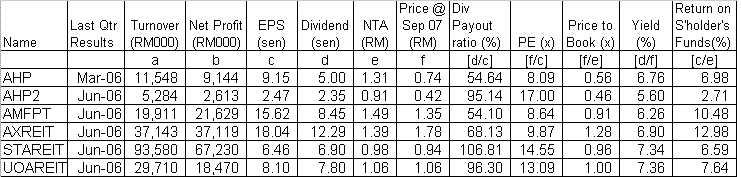
I have tabulated below all the REITs listed on Bursa, except for Tower REIT & Alaqar as their records are too short. The financial results of AHP, AHP2 & AMFPT are based on their latest 4 quarterly results while those of AXREIT, STAREIT & UOAREIT are annualized numbers based on the latest 3 quarterly results in the case of AXREIT & latest 2 quarterly results in the case of STAREIT & UOAREIT.


Table 1: Financial results of all REITs listed on Bursa (excl. TWRREIT & Alaqar)

From this, we can come to the following observations:

1. AHP & AHP2 are trading at substantial discount to their book value. Their Price-to-Book multiples are 0.56 times for AHP & 0.46 times for AHP2.
2. The pricing for AHP2 may reflect its poor Return on Shareholders’ Funds of only 2.71%. This return is computed by using EPS as the numerator & NTA as the denominator. The poor return for the case of AHP2 can also be seen by its high PE of 17.0 times.
3. In term of Return on Shareholders’ Funds, AMFPT & AXREIT are way above the field with 10.48% & 12.98%, respectively. Despite the high return, these 2 REITs are not among those giving the highest Dividend Yield because their Dividend Payout ratios are fairly moderate at 54.10% for AMFPT & 68.13% for AXREIT.
4. STAREIT & UOAREIT, the newest REITs on this table, have very high Dividend Payout ratio of 106.81% & 96.30%, respectively. Because of this, their Dividend Yields at above 7.3% are higher than those of AMFPT (of 6.26%) & AXREIT (of 6.90%).

So, which REITs have good value

I think we can use 2 approaches to pick the better REITs. The first approach is to select those that have the high Return on Shareholders’ Funds i.e. AMFPT & AXREIT. Between them, AXREIT has a slightly higher Dividend Yield of 6.90% as compared to AMFPT’s 6.26%. This is due to AXREIT’s higher Return on Shareholders’ Funds & higher payout vis-à-vis AMFPT. Because of these, the market is prepared to accept a higher Price to Book of 1.28 times to own AXREIT when compared to AMFPT’s Price to Book of 0.91 times.

The second approach is to select those that have low Price to Book i.e. AHP & AHP2. We have already noted the poor Return on Shareholders’ Funds on the case of AHP2. This is not true for AHP, which has a moderate Return on Shareholders’ Funds of 6.98%. This Return on Shareholders’ Funds is comparable to those of STAREIT & UOAREIT but yet, AHP is trading at a Price to Book that is about half of those of STAREIT & UOAREIT. Because of the low Price to Book that the market is prepared to pay to own AHP, AHP’s Dividend Yield of 6.76% is almost at par with that of AMFPT (of 6.9%).

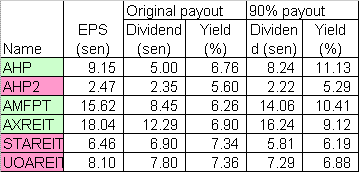
I believe that by using the above approaches, you will find AMFPT, AXREIT & also, AHP are the better REITs. Lastly, I have done a table, where I’ve equalized the dividend payout ratio of all the REITs to 90% of earning and you can see that the Dividend Yield of 3 REITs marked out in green (AHP, AMFPT & AXREIT) would move up sharply while that of AHP2, STAREIT & UOAREIT (marked out in pink) would decline. This shows that AHP, AMFPT & AXREIT have the potential to surprise on the upside.
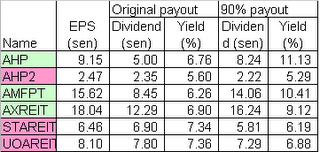


Table 2: REITs' dividend yield (currently & assuming 90% payout)


What if KLCCP & Kassets are REITs?

Some analysts have suggested that KLCCP or Kassets may be used as a benchmark for determining the performance of the REITs listed on Bursa Malaysia. Here, I would like to look at how their bottomlines would look like if they were REITs instead of being normal property investment & development companies (see the Table below).

The table below was computed based on 2 important assumptions i.e. the dividend payout ratio is at 90% & no tax is payable. The original results & the amended results are tabulated together, with the amended results marked out in yellow.



Table 3: KLCCP & KAssets' financial result & projection

From the above, we can observe the following:

1. KLCCP's Return on Shareholders’ Funds (of 10.73%) is about the same as those of AMFPT (of 10.48%) & AXREIT (of 12.98%).
2. Based on a dividend payout ratio is at 90% of earning, KLCCP's dividend yield would be about 11.56%. This would match the dividend yield of AHP (of 11.13%) & AMFPT (of 10.41%), if their dividend payout ratio is at 90%. AXREIT's dividend yield (based on dividend payout ratio is at 90%) would come out slightly short at 9.12%.

Conclusion

AMFPT & AXREIT stand out as the better-managed REITs and more attractively priced. Though AHP's Return on Shareholders' Funds is lower than AMFPT & AXREIT, it is priced accordingly and as such, it is also an attractive REIT.
Crude Oil may go to USD63-65 in the next few weeks

The price of crude oil has continued to slide as geopolitical risk recedes with the conclusion of the senseless war in Lebanon as well as seemingly milder hurricanes in the Gulf of Mexico for this year. The recent discovery of a vast petroleum pool roughly four miles beneath the ocean floor [in the Gulf of Mexico] which could hold between 3 billion and 15 billion barrels of oil and natural gas liquids has not helped the sentiment for crude oil.

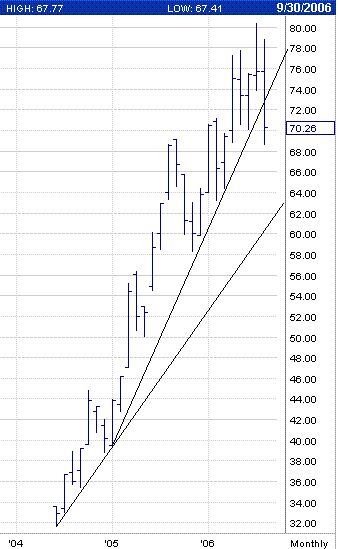
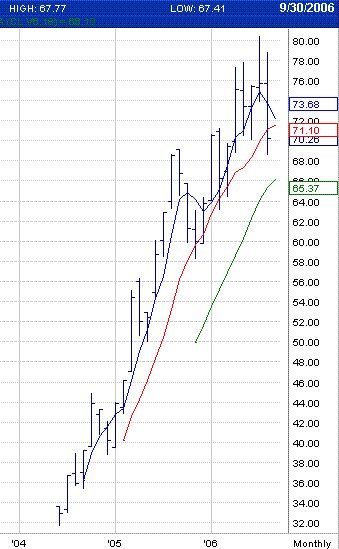
From the 3 charts below, we can see that the support for crude oil would lie somewhere between USD63-65 in the comming weeks. From Chart 1, we have plotted the long-term uptrend line for crude oil & we can see support at USD63. From Chart 2 which is overlaid with the Bollinger Bands [20,2] & Parabolic [20,20,200], we see that some support between USD63 & USD65 for crude oil. Finally, the 18-day MA would provide support at USD65.


Chart 1: Crude Oil's monthly chart as at Sep 7


Chart 2: Crude Oil's monthly chart (overlaid with Bollinger Bands & Parabolic) as at Sep 7


Chart 3: Crude Oil's monthly chart (overlaid with 4-, 9- & 18-day MA) as at Sep 7

Plantation may test its ST uptrend at 3688 soon.

Plantation may test its short-term uptrend line at 3688 before the week is out. With bearish divergence in volume as well as the MACD, my gut feeling is that it may break below the uptrend line & thereby, triggering the long-anticipated correction for the sector (see the chart below).


Chart: Plantation's daily chart as at Sep 6

Landmark- what to do next?

Background

On August 21, we have learned that Syed Yusof and parties close to him has sold off their 17% stake in Landmarks at RM2 apiece to Genting Bhd (see my post here). In that post, I’ve made a few assumptions that may not be correct and advised that the better course of action is to take profit on your investment in Landmark. I wonder whether on fuller consideration & better information, I would have recommended a different course of action because the premise of my earlier recommendation to buy Landmark was based on a fight for control. With Genting taking over from Syed Yusof , the fight for control is likely to be over for Genting is unlikely to get into a bidding war in Malaysia. What is left unresolved is why Genting bought into Landmark and that’s a moot point as far as the fight for control of Landmark is concerned.

Technical Outlook

As noted, the share price of Landmark has retraced back quite sharply since August 21 (see the chart below). The followings are noted:

1. Landmark’s medium-term uptrend line, AA may provide support at RM1.40, which also coincides with the strong horizontal support of RM1.40.
2. Landmark’s short-term downtrend line, BB may provide resistance at RM1.58/1.60 in case of rebound.
3. The 10- & 20-day MA may also act as resistance at RM1.65 & RM1.69, respectively.
4. From yesterday’s close of RM1.56, we see the next horizontal support is at RM1.52 while the next horizontal resistance is at RM1.67.

For those who are still long on Landmark & looking to sell, a good level to sell may be given by the short-term downtrend line, BB at RM1.58/1.60 or the 10- & 20-day MA may also act as resistance at RM1.65 & RM1.69, respectively.

For those who are looking for a trading opportunity, you will have to be patient & wait for the price to come closer to the medium-term uptrend line, AA at RM1.40.


Chart: Landmark's daily chart as at Sep 6

Wednesday, September 06, 2006

Public Mutual Fund is the top funds manager

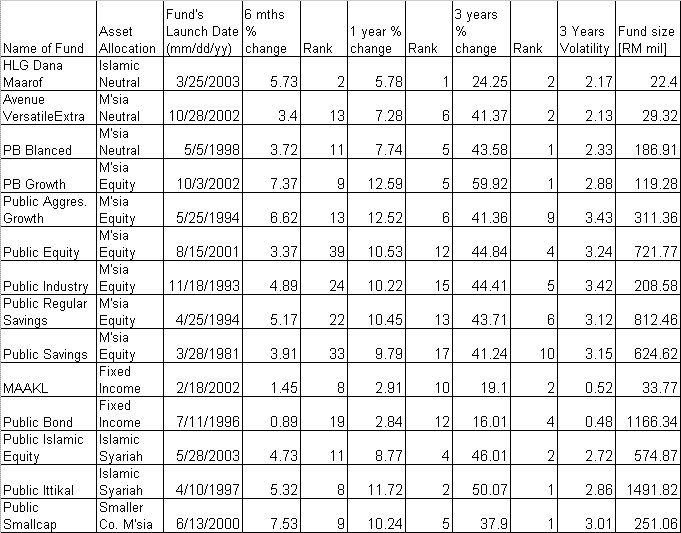
I've looked through the Standard & Poor's Fund Services' weekly table tracking the performance of unit trusts as at August 25, 2006. Something interesting caught my eyes. If you look at the 14 funds that are rated 5-star i.e. the top 10% of their respective sector (see the Table below), you would discover that 11 of them are managed by Public Mutual Funds Bhd. These 11 funds are fairly well distributed in many sectors (or, classes of assets), such as Malaysia Neutral (Equity & Fixed Income), Malaysia Equity, Fixed Income, Islamic Syariah & Smaller Companies Malaysia. Some of the funds were launched long ago, such as Public Savings (launched in March 1981) & some are fairly recent, such as Public Islamic Equity (launched in May 2003).

The out-performance of Public Mutual Funds is even more glaring when you look at the other 3 funds rated 5 stars; they consist are one fund each from MAA, Avenue & HLG. Without doubt, Public Mutual Funds is way, way ahead of its competitors. So, the next time you look for a fund to invest your money, try to pick one from Public Mutual Funds.


Table of Fund's performance as at August 25 from S&P's Fund Services

CI may have put in a top.

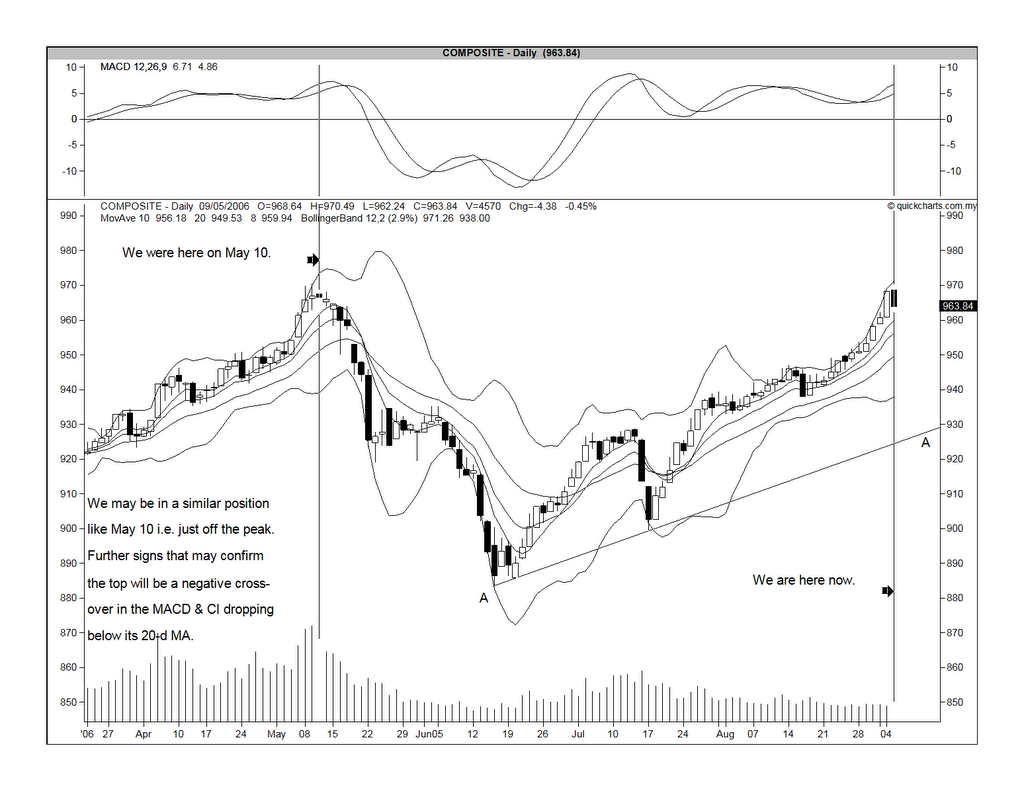
At 11.00 a.m., the CI is down 2.71 points to 961.13. A close study of the chart below has convinced me that the CI is likely to have made a top on Monday & yesterday's market action could be the beginning of a reversal. The CI is currently at a level quite similar to what it was on May 10.

On May 10, the CI had just come off a high of 970, without strong signs that there is any trouble in the horizon other than a slight "hooking-up" of the lower band of the Bollinger Bands. At that point, the CI was still way above its 8-, 10- & 20-day MA. And, the MACD had yet to do a negative crossover. All these are exactly what we have today. So, we can’t say the market has put in a confirmed top but if it follows the same path as before, we may be at the beginning of the reversal.

I have to say that the correction, if it ever happens, may not be as severe as the May & June sell-off. I believe that the likely target for this correction, if it happens, may be around 925-930 levels, given by the tentative uptrend line, AA (see the chart below).


Chart: CI's daily chart as at Sep 5

Tuesday, September 05, 2006

CI is approaching a strong resistance

The CI has been climbing a wall of worry for the past 6 weeks. As noted in an earlier post, the CI has been going up on thinning volume (see Chart 1 below). One day after a pretty decent budget that surprises many with a 2%-reduction in corporate tax rate [from 28% to 26%] over 2-year period, the CI responded in a nonchalant manner by doing what it does best i.e. to go up in an unhurried fashion and very little fuss. But, it will have to break out of its current stride soon as it approaches the important level & a pretty strong resistance of 970, which was the high recorded by the CI in May this year. While I am tempted to say that it is quite hard for the CI to break through this level, a quick look at the current CI has convincing me that I am wrong. At 9.10 a.m. this morning, the CI has indeed broken above the 970 level to reach a high of 970.49 before pulling back to 969.84. The CI will go back & forth for the rest of the day & we will have to wait for the final outcome.


Chart 1: CI's daily chart as at Sep 4

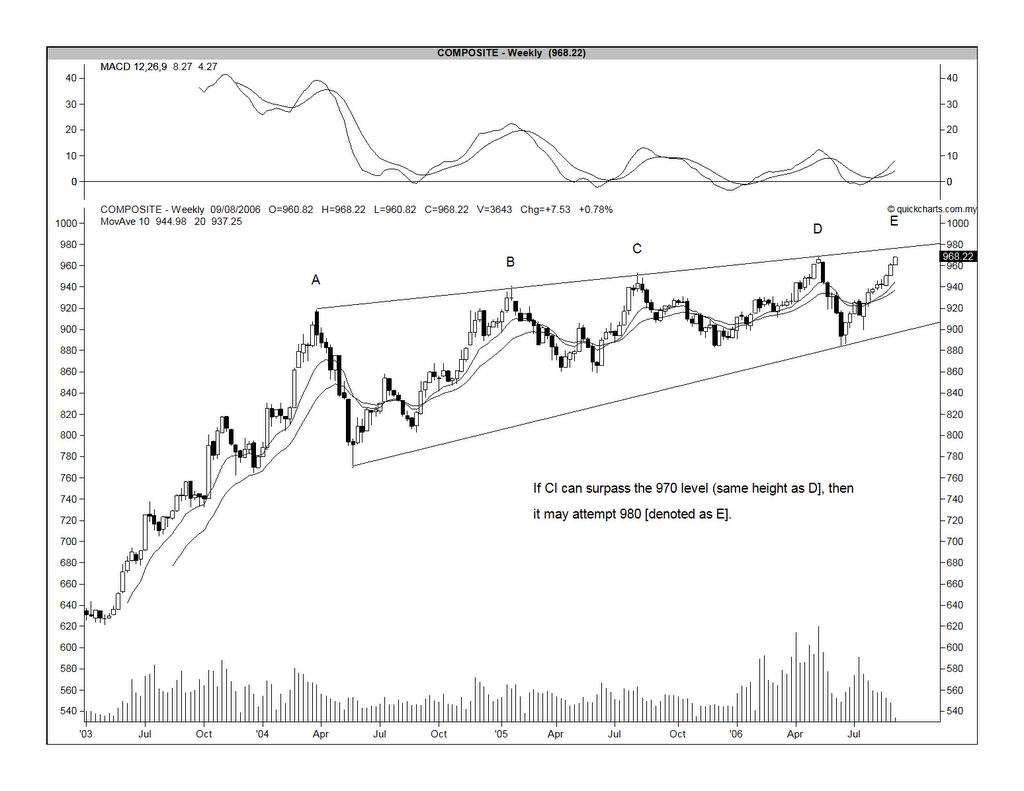
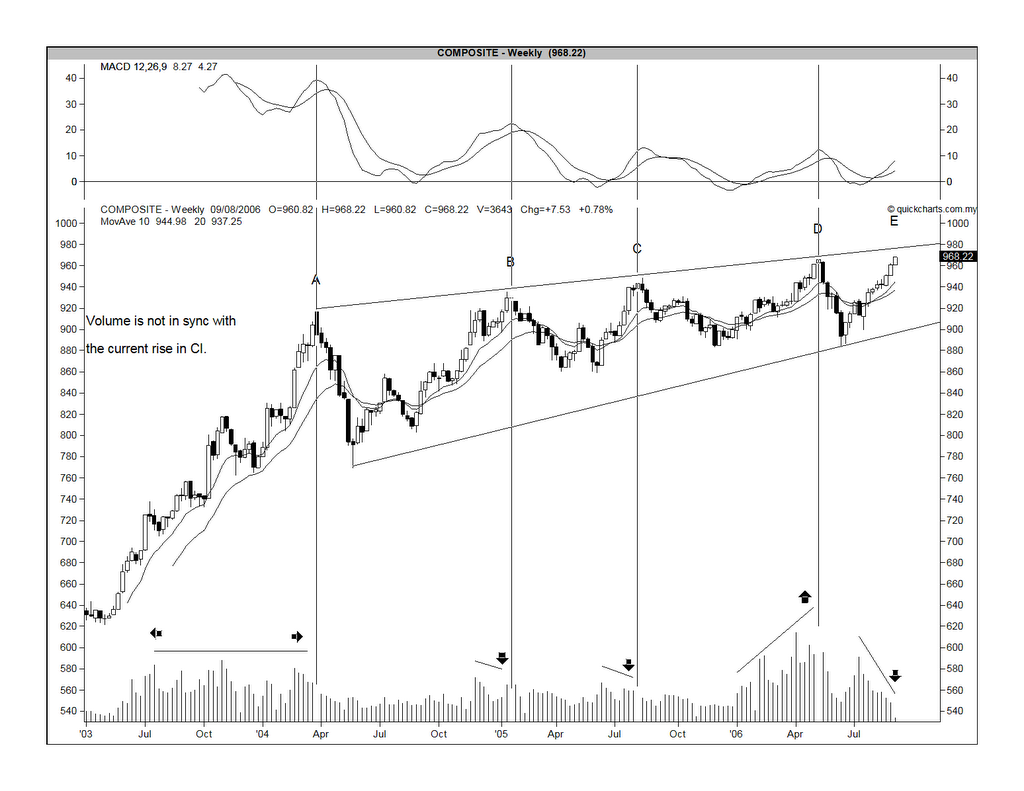
If the CI can surpass the 970 level, it may then test the 980 level. The latter is the resistance posed by the bearish wedge that the CI has been trapped in for the past 2 to 3 years (see Chart 2 below). Also, I have appended Chart 3 where you will see that the divergence between the volume & the index extends to the weekly chart as well.


Chart 2: CI's weekly chart as at Sep 4


Chart 3: CI's weekly chart as at Sep 4

So, for the next few days, we will see whether the CI can surpass the 970 level or not; and if it can do so, whether it will surpass the 980 level or not. I believe that somewhere between 970 & 980, the CI may come to “a bridge too far” & hopefully its retreat will not be too bloody.

Saturday, September 02, 2006

Linkfest

It's weekend and linkfest time again.

1. Most of you must have heard of the term “Peak Oil” and the hypothesis behind "Peak Oil" which basically says that global oil production is now at or near its peak. Once oil production starts to decline, oil shock will follow and the price of a barrel of crude will spiral to $100 or more. Paul Kedrosky presents The Case For and Against "Peak Oil".

2. Bill Gross of Pimco gives an insightful view of the challenging time ahead for American baby boomers.

3. If you have seen the movie “The Perfect Storm”, you will know what rogue waves look like. The Abnormal Returns blog discussed about this in relation to large price movements (in the financial markets), which are more frequent than what the standard finance theory has taught us. “The (excess) returns demonstrate excess kurtosis or ‘fat tails.’ It is in these fat tails where we see destructive market events” or the rogue waves.

4. Todd Harrison, the founder and CEO of Minyanville offers you the five themes that he thinks will manifest in the coming five years.

5. The Confused Capitalist says all you need is a focused portfolio of just 10 stocks. He advises investors “to dive into your own stocks to both cull the weaker positions, and to add to those positions holding the best promise”.

6. Martin T. Sosnoff, the chairman and founder of Atalanta/Sosnoff Capital, which manages assets valued at USD 5 billion, has this to say about “The Inner Game Of Investing”.
Well, that's all for this weekend. Happy reading & Happy Merdeka.

Friday, September 01, 2006

CI going up on thinning volume

The CI has broken above the upward channel at 956 levels on August 30. While the CI may rise to test the May 9 high of 970, there is some concern that this run-up, if it ever happened, would likely to be unsustainable. Why?

The current “rally” since July 18 has been quite different from the rallies in the past 8 months. Unlike the earlier 3 rallies (denoted as A, B & C in the chart below) that were accompanied by increasing volume as the rally progresses, the current rally (denoted as D), is accompanied by decreasing volume. In addition, the MACD indicator has been making lower “peaks” as the index rises. The divergence in both the volume & the MACD indicator when compared to the index raises doubt about the sustainability of the current rally.

As such, I believe that the better strategy is to sell into strength as the CI approaches the 970 levels.


Chart: CI's daily chart as at August 30

Can Java put in another scorching performance like 4Q2006?

Background

Java Inc Bhd (“Java”) is involved in the extraction of timber logs and the downstream activities of manufacturing of wood-based products. This timber operation is located in Sabah, where the group has 2 designated timber concession areas situated into: (1)Kalabakan Forest Reserve, Tawau [measuring approximately 25,000 hectares] and (2)Sungei Pinangah Forest Reserve, Keningau [measuring approximately 6,000 hectares].

Java will be venturing into the cultivation of oil palm in Kelantan when it has completed its acquisition of RSJ Trading, which has signed a 80:20 JV to cultivate oil palm on a piece of land measuring 3,120 acres in Jeli, Kelantan.

Java is the restructured successor of Aokam Perdana. Under the Restructuring Scheme completed in Dec 2004, Java acquired Key Heights (an investment company which owns subsidiaries that are involved in the timber business in the State of Sabah); implemented a 20-to-1 capital reduction; and, undertook a debt-for-share swap, a Right Issue & a Special Issue. After the completion of the Scheme, Java’s ordinary share capital increased to RM141.76 mil. At the same time, it had also issued 23.5 mil ICCPS (or, Preference Shares) and 24.60 mil warrants. Since then, 2.7 mil of the ICCPS had been converted to ordinary shares & as at today, Java’s ordinary shares stands at RM144.46 mil.

Recent Financial Performance

Java has recently announced its results for FYE2006. For the full year, Java’s net profit has declined by 50.8% to RM25.2 mil, which was achieved on the back of a 22.2%-increase in turnover to RM262 mil. The drop in net profit is attributable to an exceptional gain of RM38.6 mil recorded in FYE2005, which resulted from the write-back of provision brought about by the Restructuring Scheme. If this gain is excluded, the net profit has actually improved by 99.6% from RM12.6 mil to RM25.2 mil. I have tabulated Java's past 8 quarterly result in Table 1 below.


Table : Java's 8 quarterly results

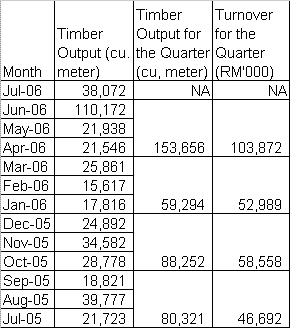
The latest 4Q2006 results show strong improvement in turnover & net profit. Net profit has increased 143% q-o-q or 123% y-o-y to RM13.6 mil on the back of a turnover of RM103.9 mil, which has increased by 96.0% q-o-q or 44.8% y-o-y (see Table 2 below). The good result can be traced to a sharp jump in timber output for the month of June 2006. In that month, timber output was recorded at 110,172 cubic meters, which is almost 3 &1/2 times the average monthly output for FYE2006. The subsequent month of July 2006 saw the output dropped back to 38,072 cubic meters (see Table 3 below). This gives rise to concern that the good result for 4Q2006 may not happen again.


Table 2: Java's latest quarterly results compared.


Table 3: Java's timber output from Jul 2005 to Jul 2006

Valuation

Since there is some doubt as to whether the 4Q2006 performance can be repeated, we shall use the 3Q2006 result as the basis for computing Java's 2007 EPS, which gives an EPS of 15.12 sen. This is deemed conservative since the price of timber logs has firmed up further since 3Q2006. Nevertheless, basing on this figure & Java's closing price at August 30 of RM0.685, Java's PE is only 4.53 times. This compared favorably to its bigger peers like WTK (with PE of 16 times) & Ta Ann (with PE of 13 times). The low PE for Java is probably due to its recent history of being a distressed company. Also, the share may suffer from selling pressure from its former creditors, who were given shares in exchange for debts.

Technical Picture

The chart below shows that Java has been bottoming out since Mar 2006. To go higher, it must surpass the RM0.69/0.70 level convincingly.


Chart: Java's daily chart as at August 30

Recommendation

Java looks like a good Trading stock since it is relatively cheap. Being a timber stock, it may also benefit from the current theme play.

Wednesday, August 30, 2006

KLCCP & Kassets- Which is more attractive?

Background

KLCC Property Holdings Bhd ("KLCCP") & Krisassets Holidings Bhd ("Kassets") are amongst the biggest property investment companies listed on the Bursa Malaysia.

KLCCP is the owner of KLCC Suria Shopping Center, the KLCC Twin Towers & a few other buildings located within the vicinity of the KLCC as well as other properties such as the Dayabumi building. In total, the properties owned by KLCCP are valued at RM6.26 billion (valuation was carried out in QE 30/6/2006).

Kassets is the owner of the Mid-Valley Megamall as well as a few other buildings located next to it. In total, the properties owned by Kassets are valued at RM1.68 billion (valuation was carried out in QE 31/3/2006). While the value of Kassets’ properties owned maybe smaller, this will be given a boost when the new phase of Mid-Valley Megamall is completed in 2008.

Financial Performance

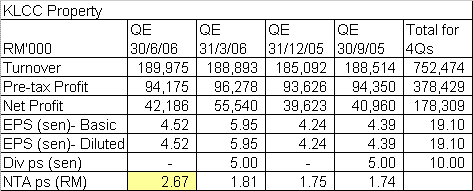
Based on the latest 4 quarterly result, KLCCP's net profit amounted to RM178.3 mil while turnover totaled RM752.5 mil. KLCCP's EPS for the 4 quarters amounted to 19.1 sen. Based on a NTA per share of RM2.67 as at 30/6/2006, the Return on Shareholders' Funds is about 7.15%.

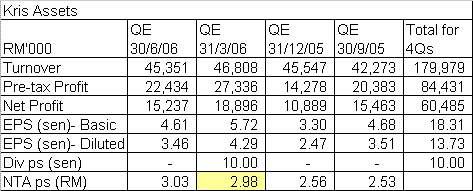
For the same period, Kassets managed to report a net profit of RM60.5 mil on the back of a turnover of RM180.0 mil. Kassets' basic EPS for the 4 quarters amounted to 18.3 sen. Based on a NTA per share of RM3.03 as at 30/6/2006, the Return on Shareholders' Funds is about 6.04%.


Table 1: KLCCP's 4 quarterly results


Table 2: Kassets' 4 quarterly results

Valuation

Based on the Table 3, we can see that KLCCP is cheaper than Kassets in term of PE multiple. KLCCP's Dividend Yield is slightly higher than that of Kassets. In term of Price to Book, Kassets is marginally more attractive than KLCCP.


Table 3: KLCCP & Kassets' PE, P/Book & Div Yield comparison

Technical Picture

From Chart 1 below, we can see that KLCCP is trapped in a range between RM2.05 & RM2.30. A move above or below these levels would signal the direction of KLCCP's next price movement. Until then, the share will be range-bound, which is ideal for swing trading.

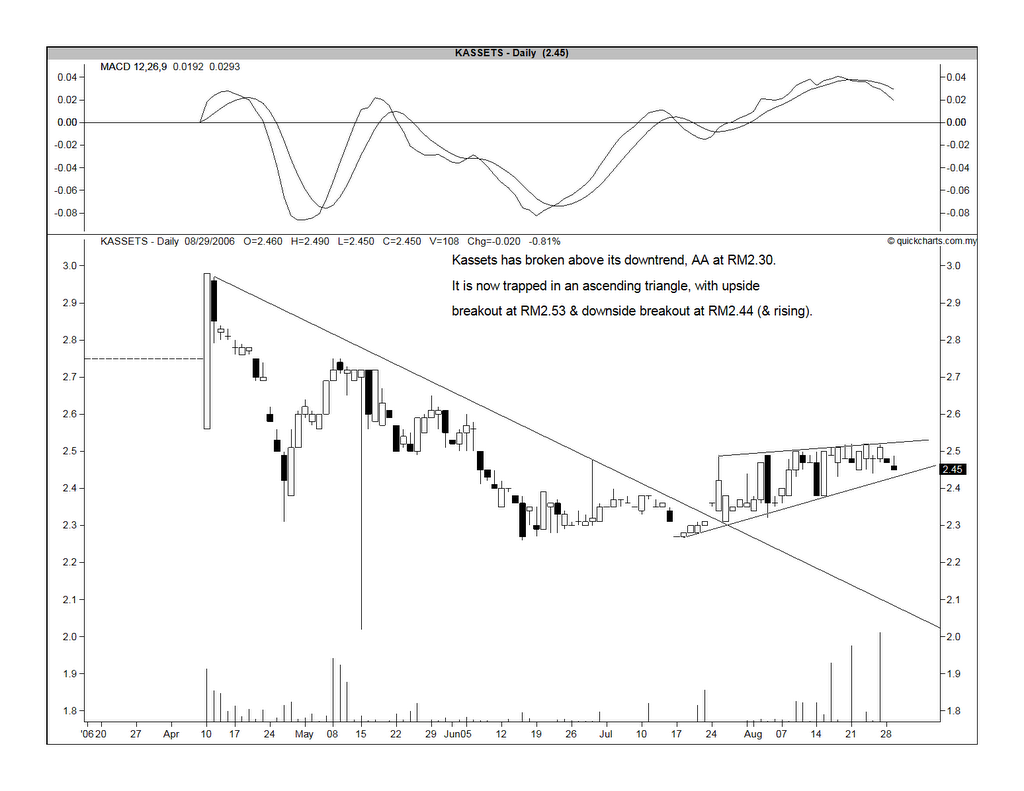
Kassets is trapped in an ascending triangle with upside breakout/resistance at RM2.53 and downside breakout/support at RM2.44 (& rising). Until then, there is not much room for trading for Kassets.


Chart 1: KLCCP's weekly chart as at August 29


Chart 2: Kassets' daily chart as at August 29

Conclusion

Based on the above, we can see that KLCCP is fundamentally more attractive than Kassets. Technically speaking, KLCCP offers some rooms for swing trading until it breaks out of its trading range (RM2.05-2.30) while one has to be patient to wait for Kassets to do a positive breakout at RM2.53, before a technical "buy" signal is activated.

Update made on September 11, 2006

From The Edge w/e Sep 11, I have learned that Kassets owns only the Mid-Valley Megamall. The other components of the Mid-Valley project such as the 4-star Boulevard Hotel, 3-star Cititel Hotel, Menara IGB, Centrepoint North & South office towers plus the Phase 2 of the Mid-Valley project such as the upscale shopping mall (known as The Garden), another 2 office blocks, a 5-star hotel & a block of upmarket service apartment are all held directly under Kassets' parent company i.e. IGB.

Please note that the earlier background information on Kassets made in this post were incorrect.

Plantation may consolidate soon

Plantation sector has been having a fine run-up. In the past 3 months alone, the Plantation index has jumped from 2996 on Jun 20 to a high of 3742 on Aug 14. As noted in my previous posts, the Plantation index may test its all-time high of 4043 done in Jan 1994. To do that within the next few months would require Plantation index to do a parabolic rise.

What do you need to achieve that? Firm price for CPO. More output coming on-stream. What about demand for all those additional CPO output? Well, there is the growing demand from China & India. What else? There is the new source of demand from the Biofuel sector, courtesy of the strong price of Crude Oil. All these were present in the past few months and they have helped to push the share prices of plantation stocks so strongly that 3 favorite plantation stocks have surpassed the targets set by analysts, according to a report that I've read. The 3 stocks are PPBOil, IOI Corp & KLKepong. Smaller plantation stocks have moved up and even Kumpulan Guthrie has moved from a low of RM2.56 in Jun to a high of RM3.84 on Aug 22.

At times like this, you need to ask the all-important question: Is there anything that I have missed out? Is this the Best of the Best? If the answer to the first question is probably “No” and to the second one is likely to be “Yes”, then you have to be wary. You need to know what would happen to the price of CPO if the off-take (or demand) cannot match with the huge jump in output. In the last few years, we have all been blanketed from time to time by haze, which originated from Indonesia. The haze tells a story of the wholesale clearing of forest for the planting of oil palm. Indonesia will emerge as the largest producer of palm oil, with an output for 2006 estimated to be about 16.4 mil tonnes as compared to 15.7 mil tonnes to be produced by Malaysia. Indonesia has 3.7 mil hectares of planted oil palm estate currently (which matches that of Malaysia) and another 6 mil hectares available for planting in the next few years. Even if you ignore the new area to be planted, the additional area that will come into maturity will increase & so will the output of palm oil. The demand for palm oil for biofuel is dependent on regulation and the price of diesel (or, crude oil). During the current boom in the price of crude oil, biofuel demand & its corollary demand for palm oil may be strong. What would happen if the price of crude oil retreats from its current height to a more pedestrian level? Would the demand for palm oil for biofuel evaporate? Can the consumption demand alone absorb all the increased output of palm oil?

As always, the chart may show us where the market is now. From the daily chart (Chart 1), you can see that the Plantation index is in a ST uptrend with support at 3620. The Bollinger Bands have tightened & the market is awaiting the completion of the current correction. There is currently no hint as to the future direction of the index. Since the index is in a ST uptrend, the probability favors the index going higher.

From the weekly chart (Chart 2), you can see that Plantation index is at a crossroad. The Bollinger upper band has started to flatten out. This is normally the precursor to a decline in the Bollinger upper band and a correction on a longer timeframe for the index. You may compare the current standoff to the consolidation in April 2004.


Chart 1: Plantation index's daily chart as at August 29


Chart 2: Plantation index's weekly chart as at August 29

Crude Oil just broke below USD70

On August 17 & 18, I've made some comments about the outlook of the Crude Oil (here) & (here).

Back then, we saw the Light Crude Oil future contract (as traded on NYMEX) tested the uptrend line at USD70 & re-bounded to a high of about USD73.80. Thereafter, it has been drifting downward & yesterday, it broke through the uptrend line & psychological support of USD70.

Looking at the chart below, you can see that the correction this time (denoted as B) is somewhat similar to the correction during the period of Nov & Dec 2005 (denoted as A). Crude Oil is now at the lower band & it may stage a rebound just like in Dec 2005. The important difference is that the Bollinger Bands in the earlier period seems to be tightening (or, merely moving parallel each other) but this time, the Bollimger Bands appear to be expanding. Since the direction of the current move is downward & it has just broken below the uptrend line, there is a higher probability that Crude Oil may not re-bound from the lower band. Instead, it may break through the lower band & drop sharply. Well, let's wait & see.

Tuesday, August 29, 2006

Megan testing its Jan low of RM0.565.

On August 21, I've recommended Megan as a good long-term investment. This is a technical update.

Today, Megan has broken below the Jan low of RM0.565. It went as low as RM0.555 before recovering to close at RM0.57. The last two days & today's volume traded are fairly big. Over the next few days, the selling may continue. We will have to wait & see whether this important horizontal support will hold or break.


Chart: Megan's daily chart as at August 28

RUBhd has broken above its LT downtrend at RM1.28/30.

Background

Ranhill Utilities Bhd ("RUBhd") is involved in the collection and treatment of raw water and the distribution of treated water to consumers in the State of Johor, commencing from 1 March 2000 for a period of 30 years. The water supply concession is held by RUBhd's wholly-owned subsidiary, SAJ Holdings Sdn Bhd ("SAJH"). RUBhd is, in turn, a 70%-owned subsidiary of Ranhill Bhd.

Until recently, the water distributed by SAJH comes from 3 sources- its own treatment plants, 2 plants belonging to Equiventures Sdn Bhd and 14 plants belonging to Southern Water Corporation Sdn Bhd. The water supplied by Equiventures & Southern Water Corp accounts for 65% of all the water distributed by SAJH.

Under the terms of the original Concession Agreement, SAJH is entitled to a tariff review every three years. The last review was supposed to be on Jan 1, 2005. The management believed that SAJH was entitled to request for a 48%-hike in the tariff rate but the State Government had requested SAJH to forego the tariff hike in return for some concessions, which would lower the cost of water purchased by SAJH. These concessions were to be implemented via a restructuring scheme (for more details of the scheme, go to the end of this post).

Recent Financial Performance

RUBhd has recently announced its result for QE30/6/2006. Net profit has increased by 5.7% y-o-y to RM33.0 mil but declined by 17.8% when compared to net profit for QE31/3/2006 of RM40.2 mil. The latter was attributable to the increase in depreciation charge and finance costs as a result of the increase in completed projects. Turnover has increased by 4.8% q-o-q or 8.4% y-o-y to RM146.6 mil.

When a comparison is made between the latest 4 quarterly results with the preceding 4 quarterly results, you can see that turnover has increased by 10.6% to RM560.2 mil while net profit has increased by 50.3% to RM127.5 mil. EPS has also improved by 50.3% from 28.8 sen to 43.3 sen. For more, see the table below.


Valuation

Based on a EPS of 48.3 sen & yesterday (August 28)'s closing price of RM1.35, RUBhd is now trading at a PE of 2.8 times. That is very, very cheap. It is so cheap that it makes you wonder why. Could it be because of the uncertainties surrounding all water stocks now, or is it something else?

Technical Picture

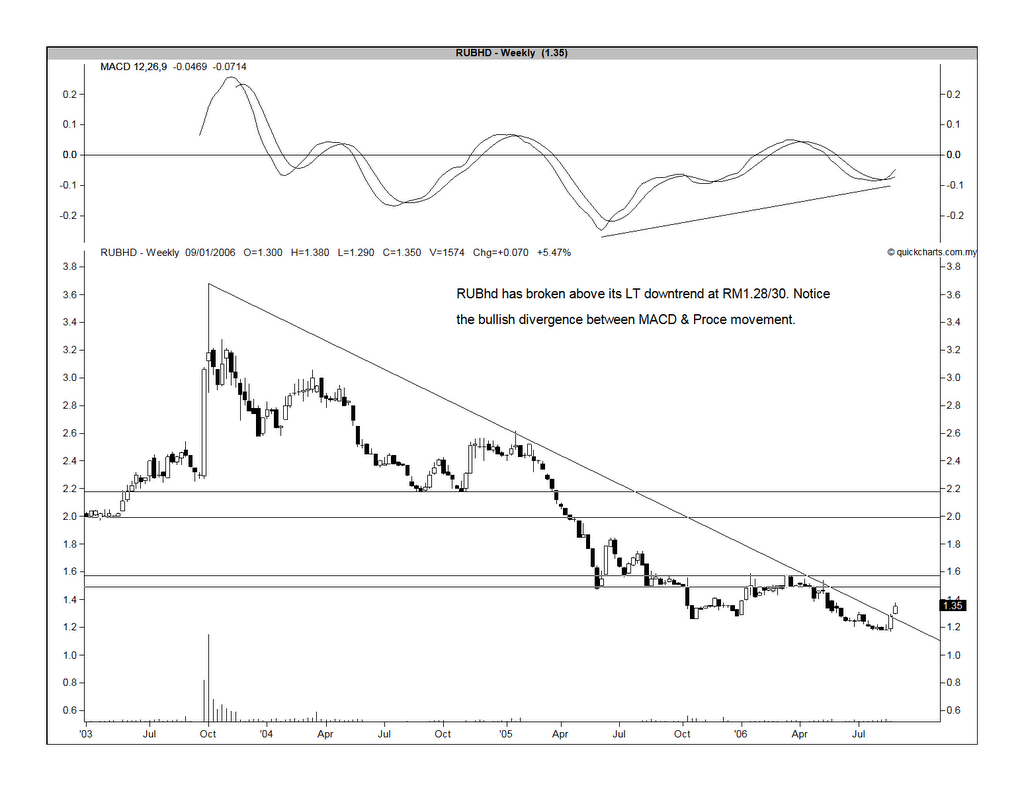
From Chart 1, you can see that RUBhd has broken out of its long-term downtrend yesterday when it surpassed the RM1.28/30 resistance to close at RM1.35. From the daily chart (Chart 2), you will see that the current share run-up is quite bullish, with runaway gaps present but unfortunately with only small volume. If exhaustion set in, the pullback can be quite substantial. The critical level that it should not breach is the RM1.28/30 level, otherwise the breakout would be deemed to be a failed breakout.


Chart 1: RUBhd's weekly chart as at August 28


Chart 2: RUBhd's daily chart as at August 28

Recommendation

Based on cheap valuation & the potentially bullish breakout on the technical front, I believe that the long-term outlook of RUBhd to be very bright.


Restructuring Scheme in more details

The main changes are:

1. SAJH is released from its obligations to purchase treated water and to pay for the bulk sales rate payment and the fixed monthly payment to the State Government and Syarikat Air Johor Sdn Bhd (“SAJSB”), arising from the purchase of treated water from the independent water treatment operators, namely Equiventures and Southern Water Corporation (“Water Operators”). Instead, SAJH will purchase treated water from Johor Special Water Sdn Bhd, a single purpose company set up by the State Government ("SPV") in accordance with the terms of the Water Supply Agreement.

2. During the supply period [3 months from Jan 1, 2006 to Mar 31, 2006], SPV shall purchase from the State Government and SAJSB such quantity of treated water that they are obligated to purchase from the Water Operators and shall supply the same to SAJH. The amount of water to be supplied is 97,700,000 m3 at a cost of RM90.0 million. This amount shall be paid by installments on deferred payment basis from the year 2007 up to 2013.

3. Upon expiry of the supply period (i.e. Apr 1, 2006), the SPV will lease water treatment assets (handled over by the Water Operators) to SAJH for the period up to 2014. The total lease payment will be up to RM1.015 billion to be payable from 2014 to 2025.

4. After 2014, SAJH shall continue to use the leased water treatment assets until full settlement of the sum of RM1.015 billion and thereafter the assets shall be transferred to SAJH, on payment of a minimal sum.

Implementation of the Restructuring Scheme

By now, SAJH should have taken possession of the leased water treatment plants but that has not happened yet. This is because the Restructuring Scheme has yet to be fully implemented. The SPV is now nearing the completion of their bond issuance and thereafter, the Water Operators will be paid for transferring over their water treatment plants to the SPV. Despite the delay, the water supply has not been interrupted & RUBhd has been holding up to their end of the bargain (which is not too hard since it doesn't have to do anything).

Ann Joo has a bullish breakout at RM1.23

Ann Joo Resources Bhd ("Ann Joo") is involved in the trading in hardware, steel & iron products and building & construction materials of all kinds as well as involved in the manufacture & trading of steel bars & billets, cast iron products, sluice valves & other steel related products.

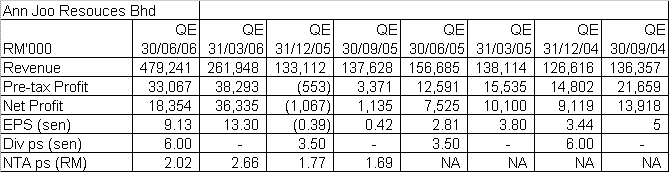
Its financial performance has improved considerably since the incorporation of Malayawata’s results as a subsidiary of Ann Joo (in January 2006). Ann Joo's turnover for 2Q2006 ending 30/6/06 has increased 83% q-o-q or 206% y-o-y to RM479 mil. Net profit increased 144% y-o-y to RM18.4 mil but dropped 49.5% when compared to the net profit for the immediately preceding quarter (i.e. 1Q2006). This is because Ann Joo's 1Q2006 ending 31/3/06 has been inflated by the following:

(i) recognition of the net excess of net assets over cost of business combination amounted to RM22.29m following the completion of the conditional voluntary offer by Ann Joo whereby Malayawata becomes a 67.67%-owned subsidiary of Ann Joo; &
(ii) recognition of gain amounted to RM10.41m arising from the completion of the disposal of a piece of leasehold land together with buildings erected thereon.

For details of the last 8 quarterly result, see the table below.


Based the EPS of 9.13 sen for QE30/6/06, we can calculate the full year's EPS to be 36.52 sen. At this EPS & using yesterday (Aug 28)'s closing price of RM1.28, Ann Joo's PE is about 3.5 times. That is very attractive.

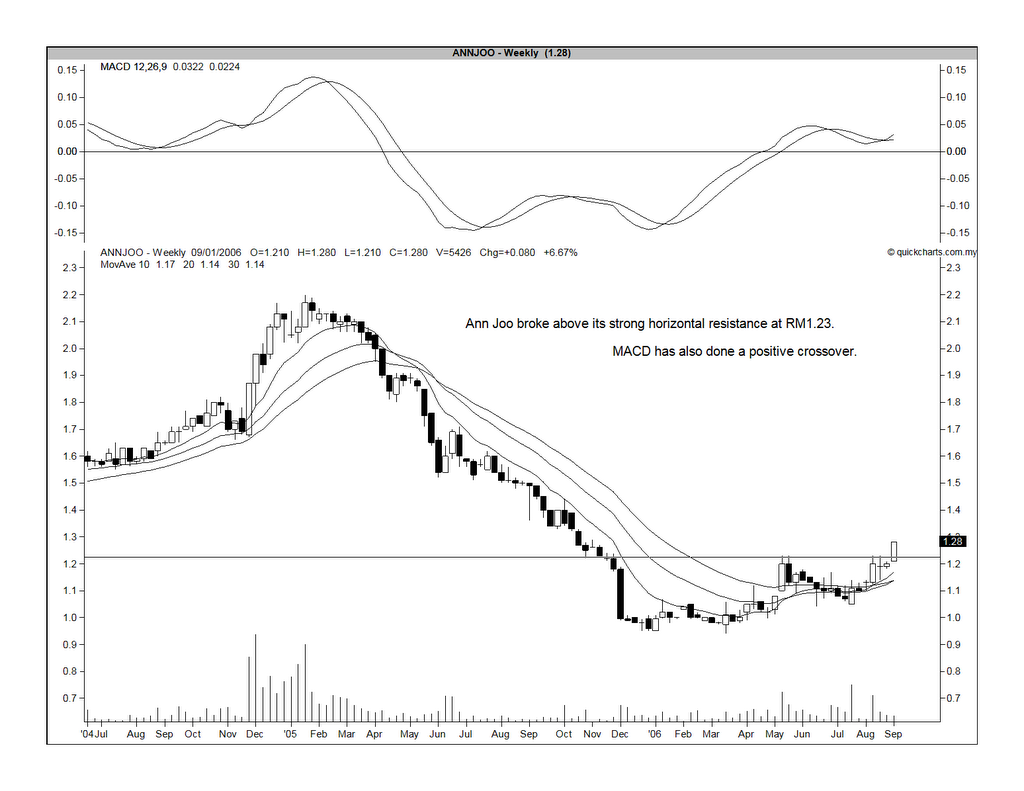
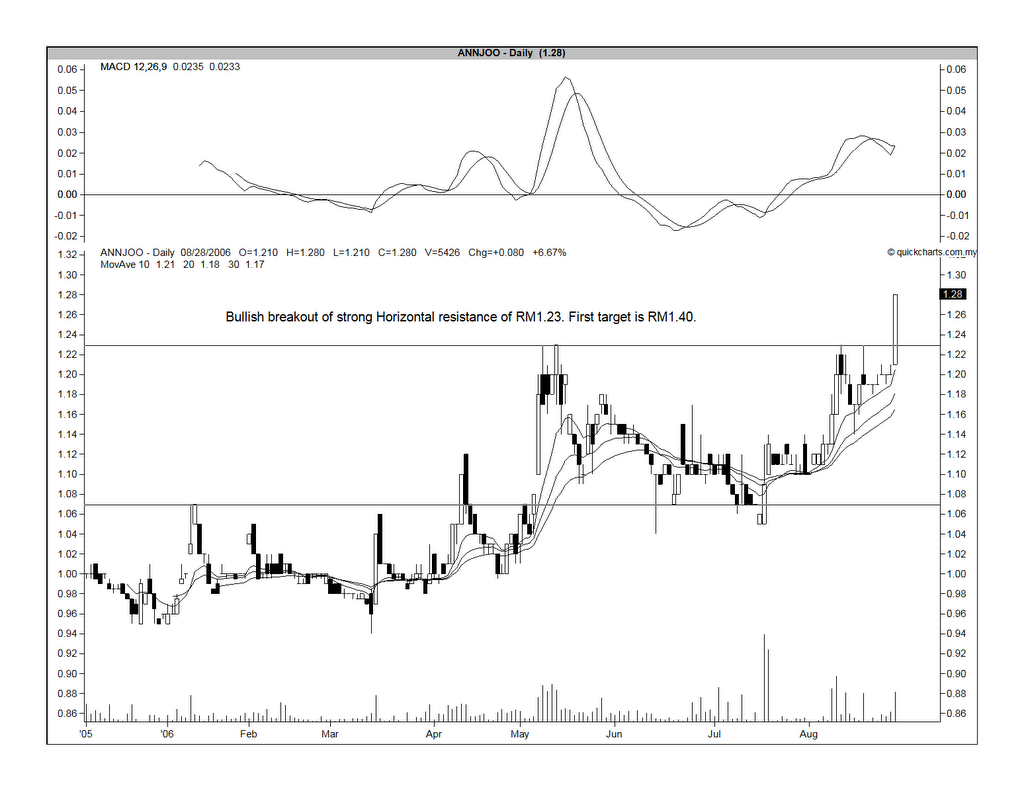
Yesterday, Ann Joo has broken above a very strong horizontal resistance of RM1.23, to close at RM1.28. At the time of writing this post (10.00 a.m.), it is at RM1.32. The first target is about RM1.40 but longer-term, I think this stock can still go higher (see the weekly & daily charts below).


Chart 1: Ann Joo's weekly chart as at August 28


Chart 2: Ann Joo's daily chart as at August 28


Based on the above, I believe Ann Joo to be a good LT investment.

Saturday, August 26, 2006

Linkfest

Linkfest time again.

For this week, we shall have:

1. A recent article in The Stock Advisors on Neil Macneale, who writes a newsletter that is based solely on stocks that have split their shares. Since July 1992, a portfolio based on this strategy grew 585%, nearly three times the 205% return of the S&P 500. Hmmm, I wonder how well a similar portfolio in Bursa will perform since we have many share splits of late. For more, go here.

2. Which works for you- investing via themes or based on a combination of value & growth? The Confused Capitalist thinks he may have the answer. (Here)

3. Some of you may have heard of Jim Cramer, the director and co-founder of TheStreet.com and former principal at hedge fund Cramer Berkowitz. His insight on the stock market is considered by many to be among the best on Wall Street. In Madd Money recently, we were given Jim's 10 Commandments of Trading. (here)

4. There are unconfirmed reports (reads: rumours) that there exists a group of powerful men in Washington, known as the Plunge Protection Team, which works secretly to protect the US stock market from plunging in critical moments, like right after September 11, 2001. From New York Post, we have this article that goes somewhere to confirm that this rumour may not be so wild after all.

5. Further warning signs that US economy may be in trouble. (here)

6. For those who wants to make trading a full-time profession, go here.

7. Other trading tools include Bollinger Bands, Multiple Moving Averages & Fibonacci Retracement.

Have a nice weekend.

Friday, August 25, 2006

A tale of two car companies

Recently, the 2 companies that are involved in the sale & distribution of our 2 national cars i.e. Proton & Perodua have reported their results for the QE 30/6/2006. As you may know, EON is the super dealer of Proton passenger cars while MBM is largest dealer of Perodua passenger cars. The difference in the financial results speaks volume about how far the fortune of the Proton marquee has fallen. See for yourself.


Table 1: EON's QE 30/6/2006 results


Table 2: MBM's QE 30/6/2006 results


In this week's issue of the Edge, it was noted that for the month of July, the number of Proton car registered with the RTD was "just over 10,000 units" while the number of Perodua cars registered was "just 13,800". If that looks bad for Proton, you may be even more surprise to learn that July was suppose to be a good month for Proton because the July number represents a 20%-improvement over the June number while for Perodua, the July month was its second worst month for this year.