Tuesday, October 17, 2006

Magnum- Would it outperform BJToto?

Background

In the past 3 years, investors have been dazzled by BJToto as much as they have been puzzled by Magnum. In two important areas, BJToto has outperformed its rival, Magnum and they are:

1. Past Financial performance

BJToto's net profit has grown from RM284 mil in FYE30/4/2001 to RM465 mil in FYE30/4/2006, on the back of a turnover that has grown from RM2.333 billion to RM2.938 billion. Magnum has grown at a slower rate from RM261 mil in FYE31/12/2000 to RM336 mil in FYE31/12/2005, on the back of a stagnant turnover of RM2.7 billion. As a result thereof, BJToto's EPS has increased from 21.0 sen to 34.4 sen while Magnum's EPS has increased from 8.7 sen to 13.6 sen. See the 2 tables below.


Table 1: BJToto's past 6 years' financial performance


Table 2: Magnum's past 6 years' financial performance

2. Dividend payout plus capital repayment

From June 2003 until today, BJToto's dividend payout totaled RM1.57 per share as compared to RM0.42 per share for Magnum. That means BJToto's dividend payout is 274% higher than Magnum's dividend payout. In addition, BJToto has also carried out 2 capital repayments of RM0.50 each in Sep 2005 & Jun 2006. See Chart 1 & 2 below.

On the other hand, Magnum has spent RM285 mil to buy back 133,051,800 units of its own share from 24/7/2001 to 2/5/2006. On 19/6/2006, the entire Treasury shares outstanding of 133,051,800, which represented 8.43% of Magnum’s issued shares, were cancelled. This has the impact of boosting Magnum’s EPS by 9.2%. Thereafter, Magnum has continued with its share buyback & as at 16/10/2006, the Treasury shares in hand totaled 17,913,400 units.


Chart 1: BJToto's weekly chart as at Sep 22, 2006 [with gross dividend (in sen) stated near the bottom of the chart]
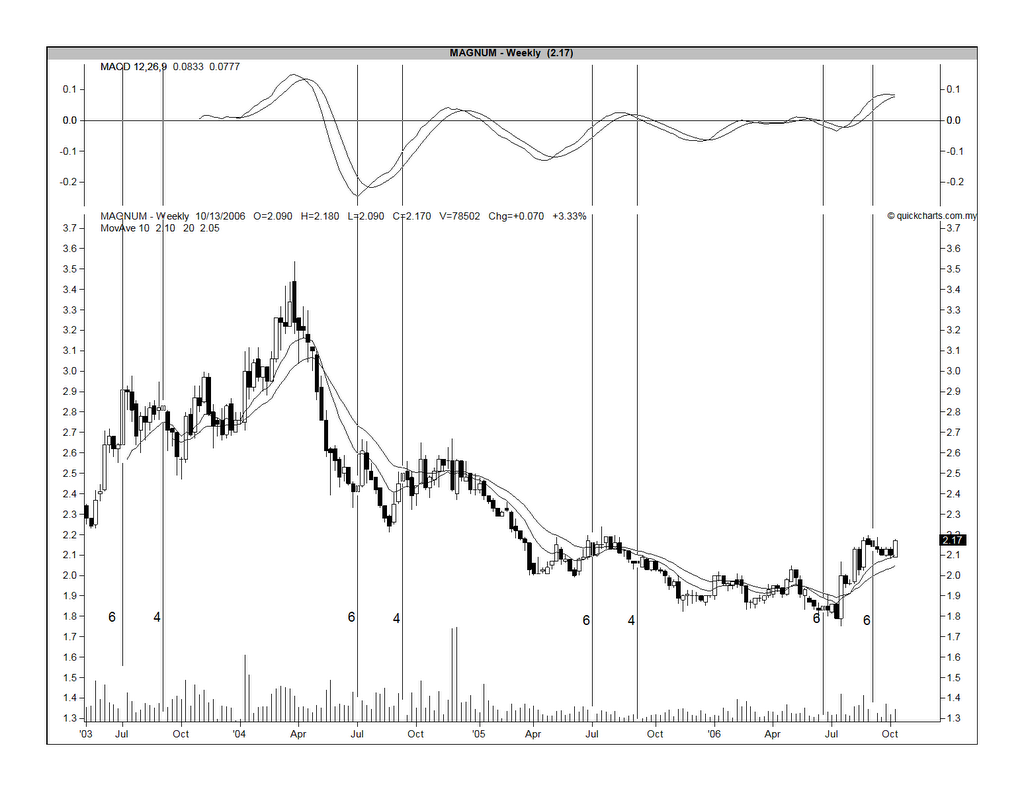


Chart 2: Magnum's weekly chart as at Oct 13, 2006 [with gross dividend (in sen) stated near the bottom of the chart]

Things a-changing

In 2 areas, things are beginning to change. They are:

1. Recent Financial Performance

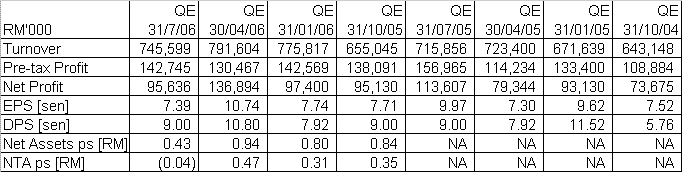
If we compared the last 8 quarters’ results of BJToto & Magnum, we can see that Magnum’s financial performance has improved substantially. Of course, one can say that the sharp improvement is due to the fact that Magnum is starting from a lower base as compared to BJToto, but a significantly higher improvement is still a better story. Here, we note that Magnum’s latest 4 quarterly’s net profit (from 1/7/05 to 30/6/06) totaled RM 210 mil, representing an increase of 172% over the net profit of the preceding 4 quarters. This is despite a turnover that has increased by only 3.5% to RM2.8 billion during the same periods.

BJToto’s net profit for the latest 4 quarterly (from 1/8/05 to 31/7/06) has increased by 18% to RM425 mil over the net profit of the preceding 4 quarters. Turnover has increased by 7.8% to RM3.0 billion during the same periods. For more detail on BJToto's recent results (which is not very straight-forward), go here. See Table 3 & 4 below for Magnum & BJToto's last 8 quarterly results.


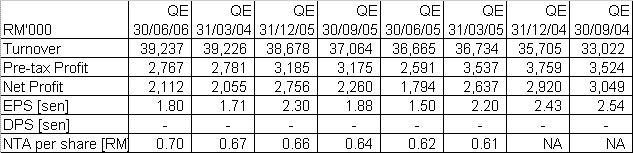
Table 3: BJToto's latest 8 quaterly results
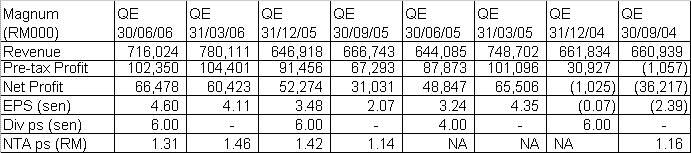


Table 4: Magnum's latest 8 quaterly results

2. Current Financial Position

After a long period of high dividend payout & 2 capital repayments totaling RM1.00 per share, BJToto’s financial position is not as strong as it used to be. Its NTA per share has dropped from a high of RM2.05 as at 30/4/02 to negative 4 sen as at 31/7/06. In addition, it has borrowing totaling RM750 mil as at 31/7/06 as compared to negligible borrowing as recently as 30/4/05. As a result, its gearing position has increased to 1.34 times its shareholders’ funds. If the cash reserves of RM402.9 mil is deducted from its total borrowings of RM750 mil, BJToto’s gearing would improve to 0.62 times as at 31/7/06.

Meanwhile, Magnum has been spending its cash reserve to buy back its shares. The amount spent was smaller & it has not reduced its cash reserve as much as the high dividend payout & capital repayment has impact BJToto’s cash reserve. As at 30/6/06, Magnum’s cash reserve stood at RM835 mil while borrowing was less than RM26 mil. Its NTA per share stood at EM1.31, of which 58 sen is in the form of cash or near-cash. See Table 5 & 6 below.


Table 5: BJToto's Financial Position for the past 6 years
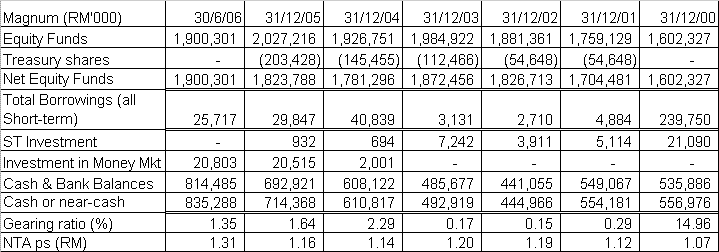


Table 6: Magnum's Financial Position for the past 6 years


What to expect from BJToto & Magnum in the near future?

For BJToto, I expect the dividend payout to normalize. Based on its last 4 quarters’ combined EPS of 34 sen & its current financial position, I do not believe BJToto can continue to pay an annual dividend of 40-50 sen much longer. I wonder how the market would react if and when BJToto shaves its dividend payout.

For Magnum, I believe that its improved financial performance coupled with its stronger financial position may enable the company do one or more of the followings:

a. To continue with its share buyback & possibly, cancellation of such shares;
b. To increase its dividend payout (as done last year, albeit on a small quantum);
c. To privatize its main subsidiary, Magnum4D & improve its result further.

Conclusion

Based on the above, I believe that Magnum is likely to outperform BJToto going forward.

Techfast- Major customer acquiring a substantial stake

Background

Techfast is involved in the manufacturing & sale of self-clinching fasteners (SCFs), that are used in the assembly of LCD and plasma screen TVs as well as PCs.

It commands an estimated 60% market share in Malaysia and exports to over 31 countries (under the trademark "TFM" which is registered in 22 countries). Exports make up 85% of revenue and 80% of profit. Techfast says its world market share for SCFs stands at around 0.4%.

Techfast's Malaysian operations in Shah Alam churn out more than 20 million SCF pieces a month, while its China set-up produces 10 million pieces a month.

Techfast has signed a shareholders agreement with 2 Thai partners to set up a manufacturing plant in Bangkok. It will hold a 55%-stake in the JV Company and production is expected to commence in November.

Since 2001, Techfast has had a strategic partnership with a well-established SCF player, the UK's Trifast plc, manufacturing SCFs for it on an OEM basis. At present, between 15% and 20% of all SCFs made by Techfast are supplied to Trifast.

Recent Development

Today, Techfast has announced that Trifast is acquiring a 25%-stake in Techfast from 4 of its major shareholders i.e. YS Yap (its chairman & MD), TO Lim (its ED), KL Fong (another ED) & CH Chin (a substantial shareholder). The 25%-stake, which represents 38 million shares, will be acquired at a cost of RM19 million cash or RM 0.50 each.

After their disposal, the 4 above shareholders’ collective stake will be reduced from 54.5% to 29.5%.

Recent Financial Results

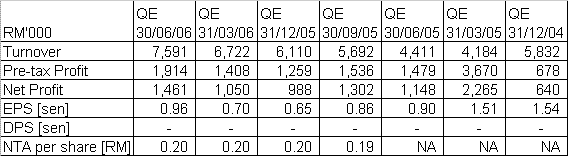
Techfast’s net profit for QE30/6/06 increased 39.1% q-o-q or 27.3% y-o-y to RM1.46 mil. This was achieved on a turnover that has increased 12.9% q-o-q or 72.1% y-o-y to RM7.59 mil. See the table below.


Valuation

Based on its EPS of 0.96 sen for QE30/6/06, Techfast’s full-year EPS would be about 3.84 sen. At a closing price of RM0.555 yesterday, Techfast is trading at a PE of 14.45 times.

Technical Outlook

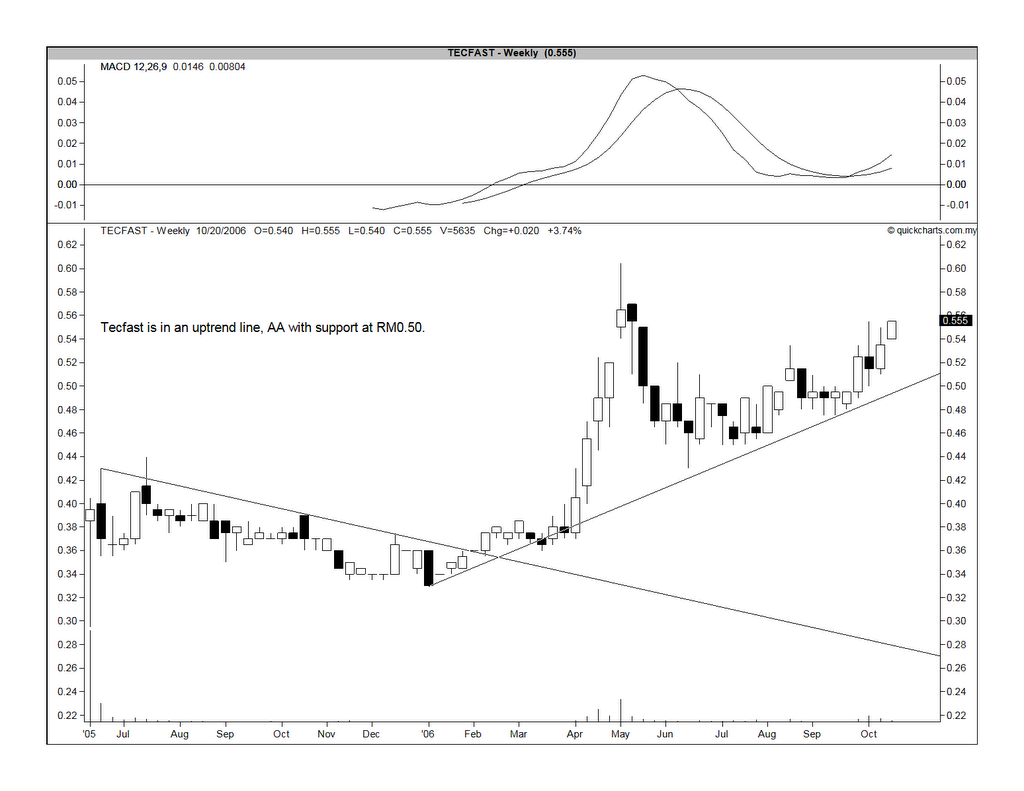
From the weekly chart below, we can see that Techfast is in an uptrend. The uptrend line support is at RM0.50. On weakness, it may drop back to the uptrend line & that would present a good entry to this stock.


Chart: Techfast's weekly chart as at Oct 16


Conclusion

Techfast is involved in a fast-growing business with very good prospect. Its major customer, Trifast sees the potential of the company & has decided to acquire a stake in the company. The key personnels remain unchanged & they still have substantial stake in the company. While the current price is not cheap, the future growth could see Techfast's net profit increasing significantly. As such, Techfast is a good long-term investment.

Monday, October 16, 2006

CI- Is it about to rally?

Last week, I've posted that the CI was poised to test the 980 level, which is the upper boundary of the bearish wedge that the CI has been trapped in for the past 3 years.

The CI has not only tested the 980 level, it has in fact broken above that level. With this breakout, the wedge would become a continuation pattern for the CI's prior trend, which is a gradual uptrend that started in March 2001. On the other hand, if the CI had broken below the lower boundary of the wedge, the wedge would become a reversal pattern.

This breakout must hold up for a reasonable duration of 3 to 5 days and it must be accompanied with a large volume (which was present for the past 2 days). See Chart 1 below.


Chart 1: CI's weekly chart as at Oct 13

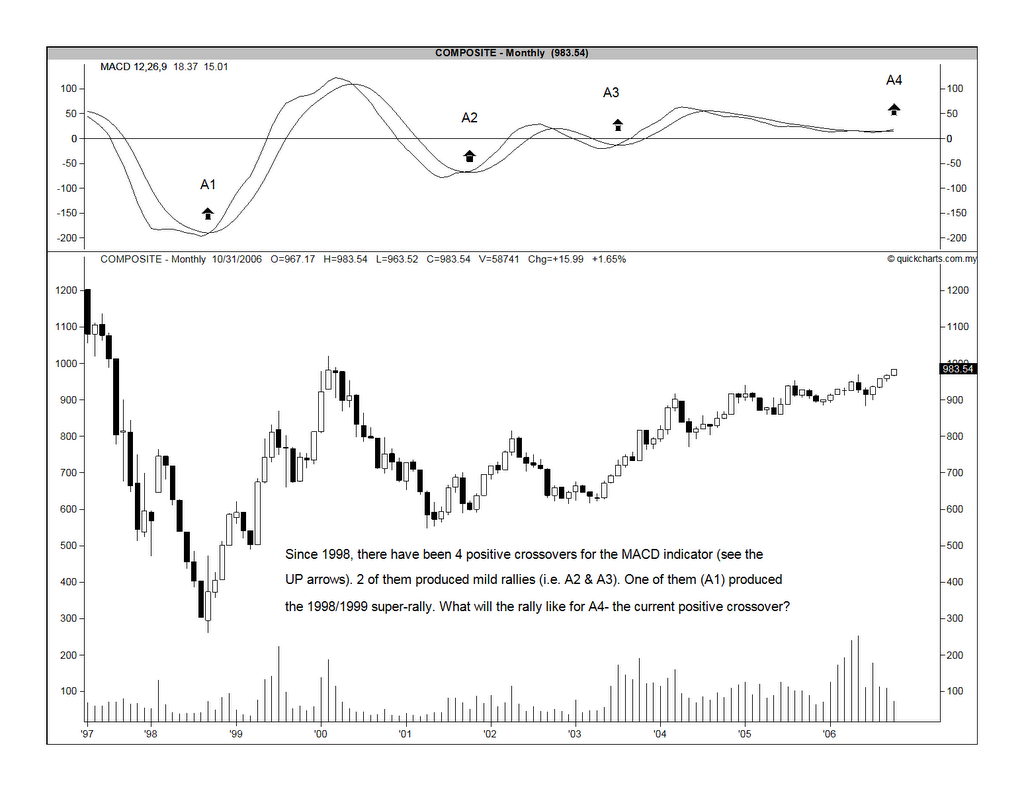
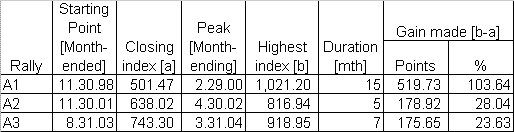
From the monthly chart [Chart 2], we can see that the MACD has done a positive crossover, albeit a very marginal one, which must be confirmed by month-end closing. This MACD crossover is a fairly infrequent positive event (read: BUY signal). In the past 8 or 9 years, there have been 3 positive crossovers [denoted in Chart 2 as A1, A2 & A3].


Chart 2: CI's monthly chart as at Oct 13

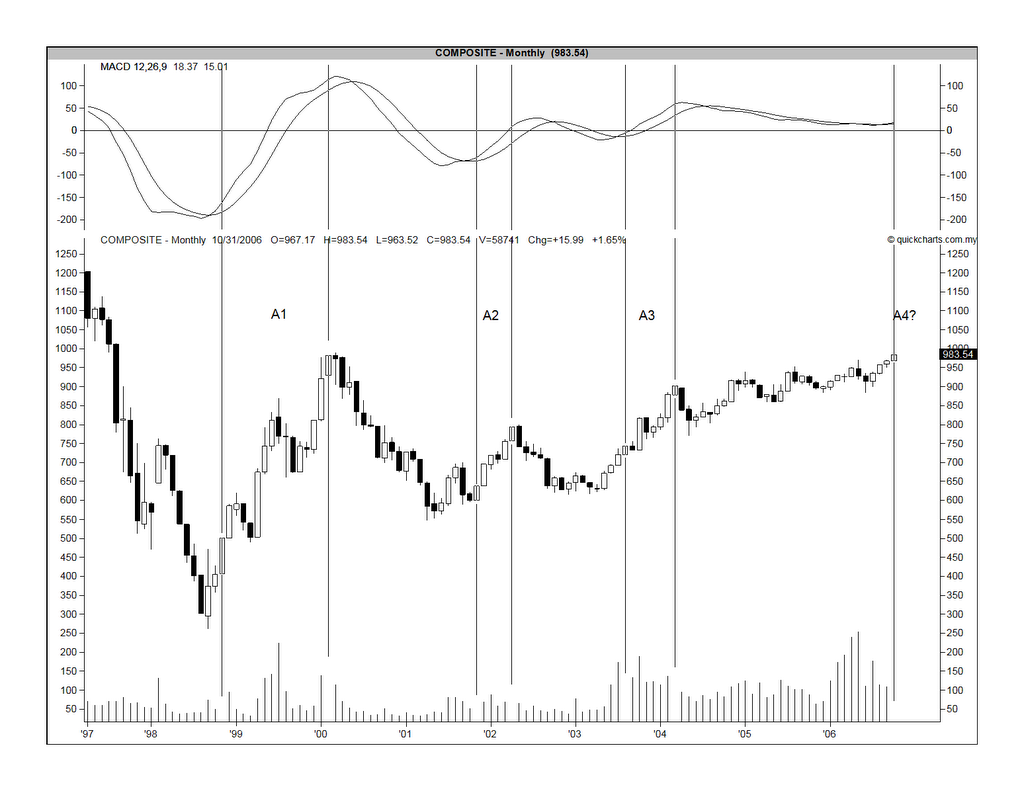
Of the past 3 MACD positive crossovers, A1 can qualify as a super-rally while the other two [A2 & A3] were mild rallies [see Chart 3 below].


Chart 3: CI's monthly chart as at Oct 13 [overlaid with vertical lines]

I have tabulated the gain made in each of the past 3 rallies from the closing index in the month where the MACD confirmation was at hand to the peak index below. We can see that a mild rally can easily lead to a gain of 20-30% while a super rally could lead to a doubling of the index (I have serious doubt about this one).


Assuming that we have a real or genuine breakout (subject to confirmation by end of this month) and the CI is at, say 985; a mild rally lasting 5-7 months could put the CI to 1182 level. I dare not extrapolate where the CI would be if we have a super rally instead.

Important note: This is just a projection, which may or may not happen. There are a number of assumptions made which may not pan out in the manner that I've written here.

Friday, October 13, 2006

Mesdaq- rise again

Mesdaq, which was in a downtrend after it put in a double-top reversal on July 13, has broken out of the downtrend line on October 3 when it surpassed the 108 level. It's currently in a short-term uptrend and it will be coming up against the horizontal resistance of 113 soon. If it can surpass this resistance, its next resistance levels are 120 & 128. On the other hand, it may weaken & fall back to the short-term uptrend for support at 110 (& rising). See Chart 1 below.


Chart 1: Mesdaq's daily chart as at Oct 12


Chart 2: Mesdaq's weekly chart as at Oct 12


From the weekly chart [Chart 2] above, we can see that Mesdaq is still in an uptrend line which commenced in December 2005. This medium-term uptrend line should provide support at 106 (& rising).

The rise in Mesdaq this round is likely to be a more subdue affair because of huge losses incurred by market players in the last round as well as closer scrutiny by market regulators. In fact, I do not see any outstanding stock in this sector right now to lead the "charge" for the rest of the Mesdaq stocks.

Call Warrants as at Oct 12, 2006

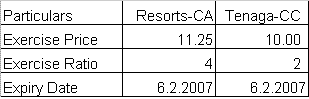
Today, two new call warrants have been listed. They are Resorts-CA and Tenaga-CC. The main terms of these call warrants are:


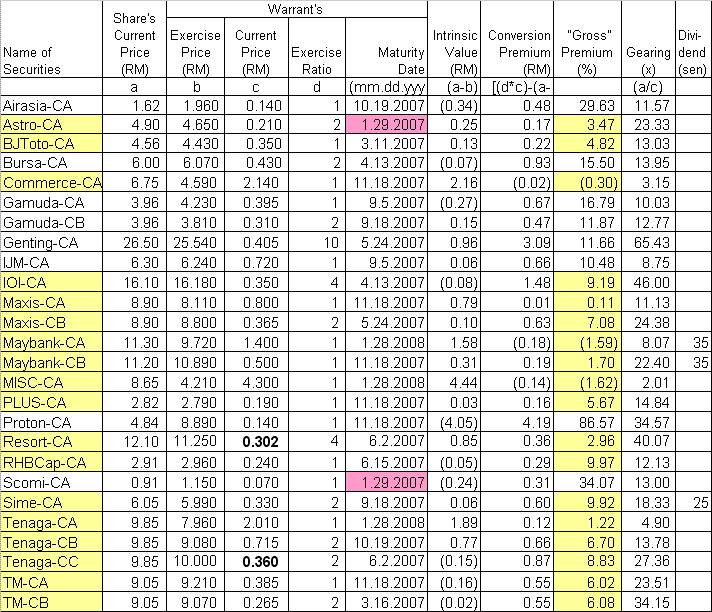
The complete table of all listed call warrants is given below:


I have highlighted all the call warrants that have gross premium of less than 10% (in yellow) as well as the 2 call warrants i.e. Scomi-CA & Astro-CA that will expire in January 2007 (in pink). The price stated for 2 new call warrants are the issue price but at 12.00 noon, Tenaga-CC and Resorts-CA are trading at RM0.45 & RM0.47, respectively.

Note: If you like to have a copy of the Excel spreadsheet for the above Call Warrants listing, please drop me a line.

Tenaga has a very good 4Q2006

Recent Financial Results

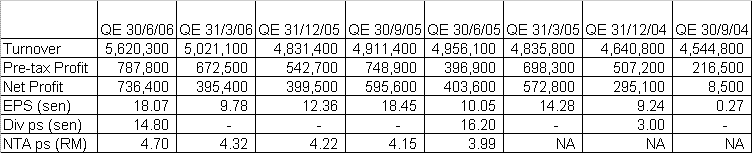
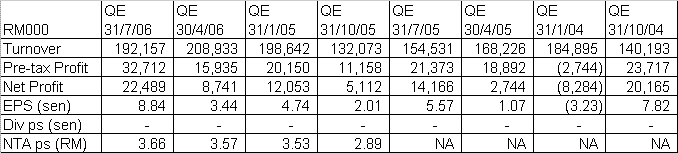
Tenaga has announced its results for FYE2006. The net profit for the Group improved from RM1,280.0 million to RM2,126.9 million, an increase of RM846.9 million. This was achieved on a revenue of RM20,384.2 million which was RM1,406.7 million or 7.4% higher than the corresponding period in the last financial year. The better performance was attributable to higher electricity sales and the strengthening of Ringgit.

For 4Q2006, Tenaga recorded a net profit of RM403.6 million on a turnover of RM5,620.3 million. When compared to the corresponding fourth quarter FY2005, net profit shows a gain of RM332.8 million [or 82.5%] while turnover increased by RM664.2 million [or 13.4%]. When compared to the preceding quarter, net profit was higher by RM341.0 million [or 86.2%] while turnover was higher by RM599.2 million [or 11.9%].

The higher electricity sales- the main reason for the outsize improvement in net profit & turnover- is mainly due to tariff review that was approved by the Government with effect from 1 June 2006. See the table below for Tenaga's last 8 quarterly result.


Valuation

Based on the EPS of 18.07 sen for 4Q2006, Tenaga's full-year EPS may amount to 72.28 sen. At yesterday's closing price of RM9.85, Tenaga is now trading at a PE of 13.6 times. At this multiple, Tenaga is very attractive as it is a defensive stock & one of the prime blue chip in Malaysia. In better time, I believe that Tenaga can command a PE of 18 times.

Technical Outlook

From the weekly chart, we can see that Tenaga is in an upward channel. The lower & upper channels are RM9.50 & RM10.40, respectively. A break above the upper channel would signal the beginning of an accelerated move for Tenaga. See Chart 1 below.


Chart 1: Tenaga's weekly chart as at Oct 12


Chart 2: Tenaga's monthly chart as at Oct 12

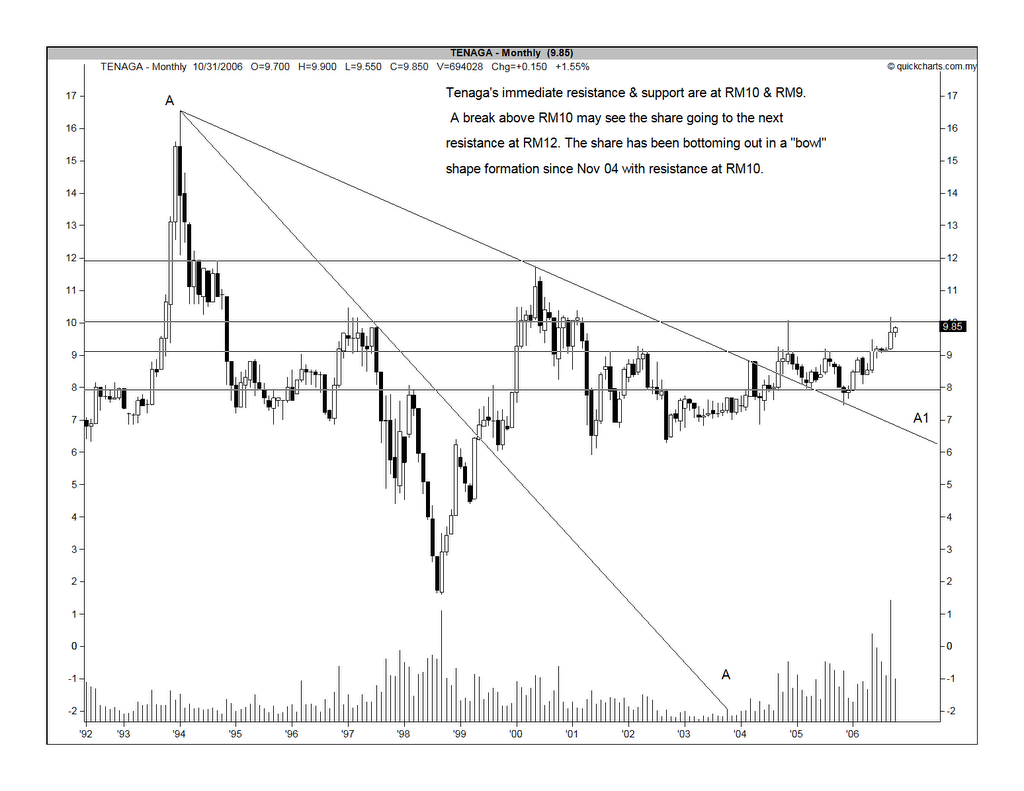
From the monthly chart above, we can see that Tenaga needs to break above its immediate horizontal resistance of RM10 in order to go higher. The next resistance is at RM12.

Conclusion

From this, you may agree that Tenaga is an attractive long-term investment.

Note: You may opt to trade on Tenaga instead of investing long-term. In which case, you can consider any one of the existing 2 call warrants [i.e. Tenaga-CA or Tenaga-CB]. The new call warrant [Tenaga-CC], which has started trading today, has a much higher premium than the existing 2 call warrants. Nonetheless, I believe that Tenaga is a stock that is more suitable for long-term investment rather than short-term trading.

Thursday, October 12, 2006

Kian Joo has broken above its downtrend line

Background

Kian Joo is involved in the manufacture of can (both, general & aluminium can) as well as PET bottles & related plastic packaging products.

Proposed Corporate Exercise

On Sep 8, Kian Joo has announced a Bonus Issue of 1-for-5 plus a share split of 1 unit of 50-sen share into 2 units of 25-sen share. On completion of this exercise, a shareholder with 1,000 units of Kian Joo 50-sen share will end up with 2,400 units of Kian Joo 25-sen shares.

Recent Financial Results

Kian Joo reported a sharply lower net profit of RM2.8 mil for QE30/6/06. This represents a 79% drop when compared to both the net profit of the preceding quarter as well as the corresponding quarter last year. Turnover at RM154 mil is 4% higher than the preceding quarter's turnover but 6% lower than the turnover for the corresponding quarter last year.

Kian Joo attributed the poorer result to the following:

1. higher material & operating cost in the general can division, which resulted in loss of RM0.91 mil as compared to a profit of RM6.8 mil in the last quarter;
2. lower revenue & higher opearting cost in the aluminium can division, which resulted in a drop in profit from RM11.7 mil to RM9.4 mil; and
3. higher resin cost, one-off re-location expenses & VSS expenses, which has led to increased losses in the PET & plastics division from RM0.7 mil to RM2.5 mil.


Valuation

Based on the last 4 quarterly results, Kian Joo's EPS is about 20.15 sen. At the closing price of RM2.63 for today (Oct 12), Kian Joo is now trading at a PE of 13.2 times. This is quite near the fair value for a stock of comparable size & quality for the Malaysian stock market.

Technical Outlook

The main attraction of this stock is that it has just turned technically bullish. The share price has just broken above its medium-term downtrend line at the RM2.55 level. We can see that it has also surpassed the immediate horizontal resistance (now, turned into support) at RM2.60 level. The next resistance is at RM3.00.


Chart: Kian Joo's daily chart as at Oct 11

Conclusion

Based on the bullish technical outlook, I believe that Kian Joo is an interesting trading buy. The recent financial results is a disappointment but with the drop in the price of crude oil and most basic metals, I believe that Kian Joo's profit margin will rebound as would its bottomline.

JTiasa has a bullish breakout at RM2.82/85.

Background

JTiasa is involved in the extraction of timber logs & further downstream processing of timber logs.

Recent Financial Results

JTiasa has just announced its result for QE31/7/06, which shows a sharply higher net profit of RN22.5 mil. This net profit is 157% higher than the preceding quarter's net profit eventhough the turnover has declined by 8.0% to RM192 mil during the periods under consideration.

When comparison is made with the results for the corresponding quarter last year, we noticed that the net profit has increased by 59% while turnover has grown by 24.4%.


Valuation

Based on the latest EPS of 8.84 sen for QE31/7/06, we can arrive at an annualized EPS of 35.36 sen. At the closing price of RM2.65 yesterday, JTiasa is trading at a PE of 7.5 times. This is not expensive and given the on-going timber play, I see JTiasa may go up higher.

Technical Outlook

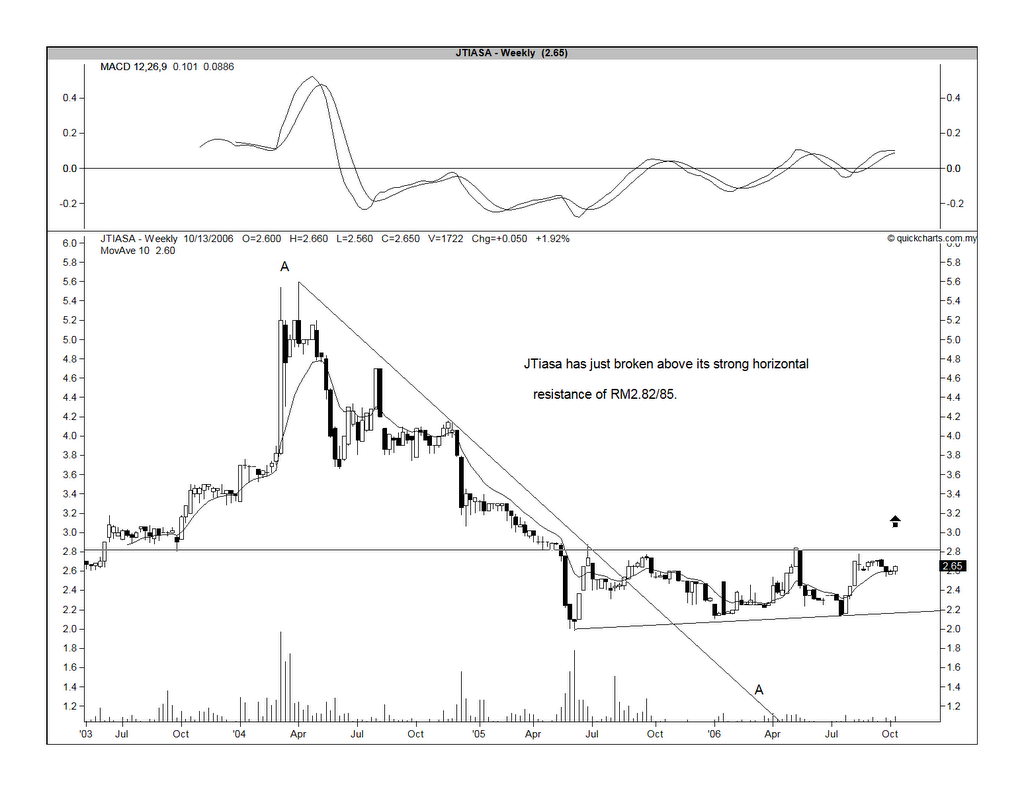
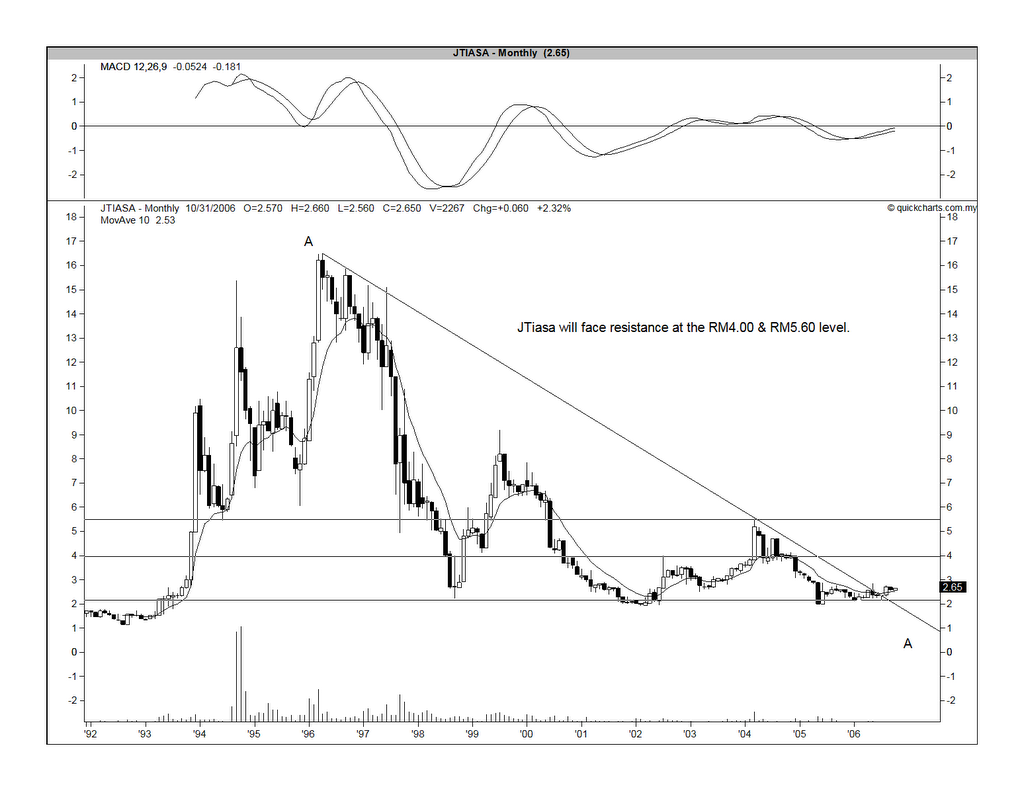
JTiasa has just broken above its strong horizontal resistance of RM2.82/85. See the weekly & monthly charts below.


Chart 1: JTiasa's weekly chart as at Oct 11


Chart 2: JTiasa's monthly chart as at Oct 11

Conclusion

JTiasa is a laggard in the on-going timber play. It is fundamentally inexpensive and it has just turned technically bullish. At the time of making post, JTiasa has gone up 25 sen to RM2.90.

CI may test the 980 resistance this week

At 10.30 a.m. this morning, the Ci is again at the 973 level, matching the high achieved on Oct 9. Gainers out-number losers 272 to 159. Volume traded is 238 million units.

The market looks like it can go higher still. The next resistance is at 980, given by the consolidation pattern in which the CI is trapped for the past 3 years. As such, the 980 resistance is a very strong resistance, which may not be overcome on first attempt. A break of this resistance will however see the market scaling heights that many market players have long given up on.


Chart: CI's weekly chart as at Oct 11

Wednesday, October 11, 2006

Kotra has a bullish breakout at RM1.50

Background

Kotra is involved in the development, manufacturing and marketing of a range of pharmaceutical products. Its products can be divided into 2 categories, which are sterile and non-sterile products. Sterile products consist of injectables in the form of liquid & powder, which provide a direct and immediate action on the end users. Non-sterile products comprise of capsules, tablets, syrup, suspension and cream, which are specifically formulated for oral and external use.

Recent Development

On Oct 9, Kotra has proposed the following:

1. A bonus issue of 6-for-5; and
2. A transfer of its listing from Mesdaq to the Main Board.

Recent Financial Results


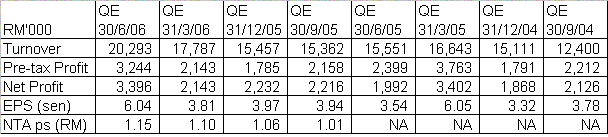
From the above, we can see that Kotra's net profit has increased by 58.5% q-o-q or 70.5% y-o-y to RM3.4 mil. This is on the back of a turnover of RM20.3 mil, which represents an increase of 14.1% over the preceding quarter's turnover or 30.5% over the turnover of the corresponding quarter last year. EPS for the last 4 quarters totaled 17.8 sen.

Past 5 years performance


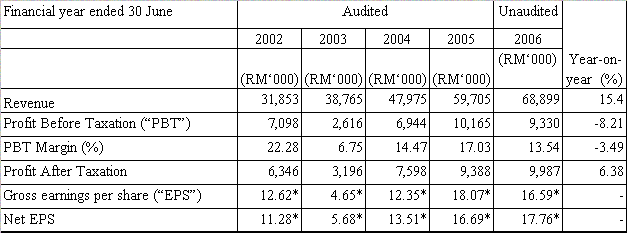
Kotra's turnover has been rising steadily from RM31.9 mil in 2002 to RM68.9 mil in 2006. During the same periods, its net profit has also increased from RM6.3 mil to RM10.0 mil. EPS has increased from 11.3 sen to 17.8 sen.

Technical Outlook

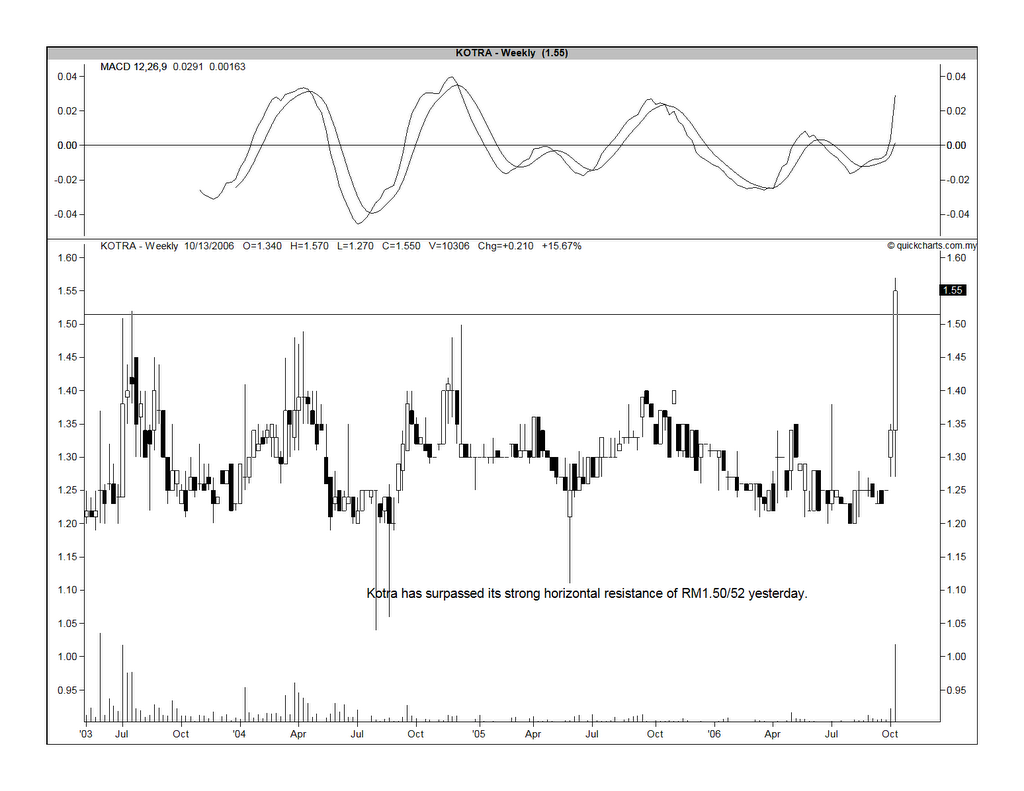
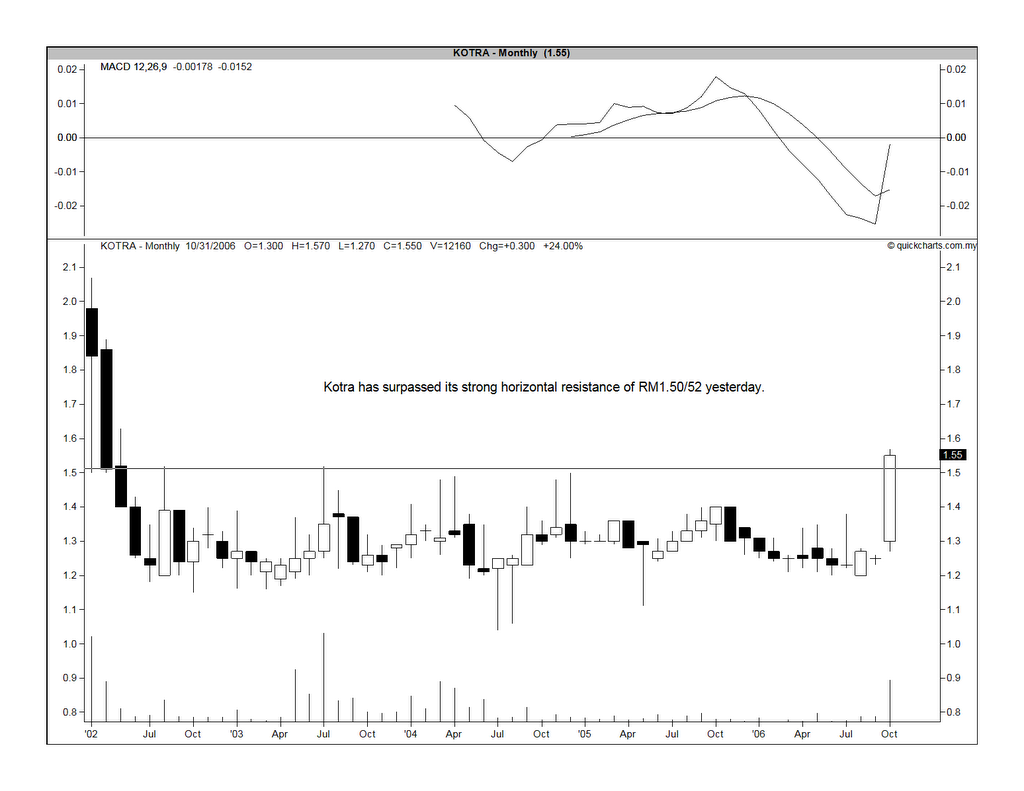
Kotra has broken above its strong horizontal resistance of RM1.50 yesterday. See the weekly chart below.


Chart 1: Kotra's weekly chart as at Oct 11

You can see that this horizontal resistance stretched back for earlier 2002. As such, this break can lead to a powerful move. See the monthly chart below.


Chart 2: Kotra's monthly chart as at Oct 11

Conclusion

Kotra could be a good trading buy. Unfortunately, this post is a tad late because the share price of Kotra is now at RM1.62.

Monday, October 09, 2006

CI is hanging on.

On Thursday, I've commented that the CI has broken below its short-term uptrend. CI has however done a good recovery job on Friday & managed to close marginally above the strong horizontal resistance of 970. In the process, it has also stayed above its short-term uptrend & its 10-day MA. With this recovery, the CI has again placed itself in a good position to do a convincing breakout.

At 10.00 a.m. this morning, the CI has gained 1.54 to 972.52. Gainers out-numbered losers 186 to 140. Volume traded is still low at 124 million units.

Friday, October 06, 2006

Courts' bad news aplenty

It is better to be more interested in the market’s reaction to new information than in the piece of news itself.

Successful traders buy into bad news and sell into good news.

by Linda Bradford Raschke


Background

1. Courts Mammoth’s controlling stake is on the selling block. This is because its parent, Courts plc is being wound up & the administrator [KPMG Corporate Finance (UK)] is seeking to sell off its 50.1%-stake in Courts Mammoth.

2. 15 bids were submitted at the end of the deadline on August 24, 2005.

3. According to the latest report by the administrator [for the month of May 2006], they are in the final process of clarifying the final bids for disposal of the remaining Asian businesses [probably including Courts Mammoth operation]. See item 3.1.4 of the report (on Page 5 of the report).

4. The timeline for the completion of the sales is the latter parts of Q4 2006. See item 3.3.1 of the report (also, on Page 5 of the report).

5. The successful bidder for the 50.1% block of shares in Courts Mammoth will have to buy out the minority shareholders. I have done a valuation of the share on a "non-going concern" basis & came up with a value of RM1.14 per share. For more details, go here.


Latest Development

1. Courts Mammoth has recently announced its results for QE30/6/06, which shows a net loss of RM12.0 mil on a reduced turnover of RM127.9 mil. For more details, go here.

2. For FYE31/3/06, Courts Mammoth recorded a turnover of RM635.46mil against RM609.25mil the previous year. Pre-tax profit declined to RM4.89mil from RM45.28mil recorded previously.

3. On October 2, 2006 [4 days ago], the company held its AGM & the Star newspaper's headline was “Courts Mammoth working to cut bad debts”.

How did the market react to the new information?

The share price dropped 2 sen to 58 sen one day after the news of the bad debts problem. The subsequent 2 days see no further selling and in fact the price has recovered marginally. See the chart below.


Chart: Courts' daily chart as at Oct 5

Should you buy into the bad news?

Note: Linda Bradford Raschke is a high successfully full-time trader. You can read some of her magazine articles (here). Her article entitled "Maintain Your Mindset, Using the Three R's of Positive Thinking" in the July 2004 issue of Stock Futures & Options is very instructive. If you just want to know about her Trading Rules, Tradergav has done an excellent job compiling them all here.

BJToto is nearing its short-term uptrend line

Background

BJToto needs no introduction. It is essentially a gaming company with the main subsidiary being Sports Toto, which runs number forecasting games such as 4 Digit, 4 Digit I-Perm, Super 6/42 & Super 6/49.

Recent Financial Results

BJToto's latest financial results for QE31/7/06 appears not too good on first glance but, on closer examination, it proves otherwise. Its turnover of RM746 mil for QE31/7/06 represents an increase of 4.2% over the turnover for QE31/7/05. Pre-tax profit of RM143 mil is however 16.9% lower than the pre-tax profit for QE31/7/05. The drop is actually due to an exceptional gain on disposal of the company's ICULS amounting to RM24 mil that was recorded in QE31/7/05. Pre-tax profit was also negatively affected by the jump in finance cost (from RM0.6 mil to RM7.7 mil), which was attributable to higher bank borrowings used to finance its Second Capital Repayment.

Turnover for QE31/7/06 is 5.8% lower than the immediately preceding quarter (QE30/4/06)'s turnover because it had one draw less in QE31/7/06 and the preceding quarter had benefitted a higher seasonal sales due to the Chinese New Year festival in February. Despite the lower turnover, BJToto's pre-tax profit improved 9.4% q-o-q mainly due to a lower prize payout. Net profit is however 30% lower q-o-q due to the write-back of over-provision of tax in prior years of RM52.7 mil, which was done in the preceding quarter.


Valuation

Based on the EPS of 7.4 sen for QE31/7/06, we can estimate BJToto's full-year EPS to be about 29.6 sen. At yesterday's closing price of RM4.60, BJToto is now trading at a PE of 15.5 times. Unless there are more games being introduced that can lead to an increase in turnover, BJToto is almost nearing its fair value.

BJToto has been a stock that attracts a lot of income-seeking investors since it pays a very good dividend. Based on last year's dividend of 52 sen, BJToto has a yield of 11.3%!!! Can it sustain this level of dividend payout based on an earning of 29.6 sen?

Technical Outlook

Based on the daily chart below, we can see that BJToto is in an upward channel. It is now in a minor corrective wave, which may see the stock coming down to test its lower channel line at RM3.48 (& rising). I believe this is a good level to buy BJToto. A break below this channel line would however be bearish for the stock.

Assuming the channel remains in tact, the stock may test the upper channel line at about RM4.90/5.00 on the next up-wave.


Chart 1: BJToto's daily chart as at Oct 5

BJToto-CA's technical outlook

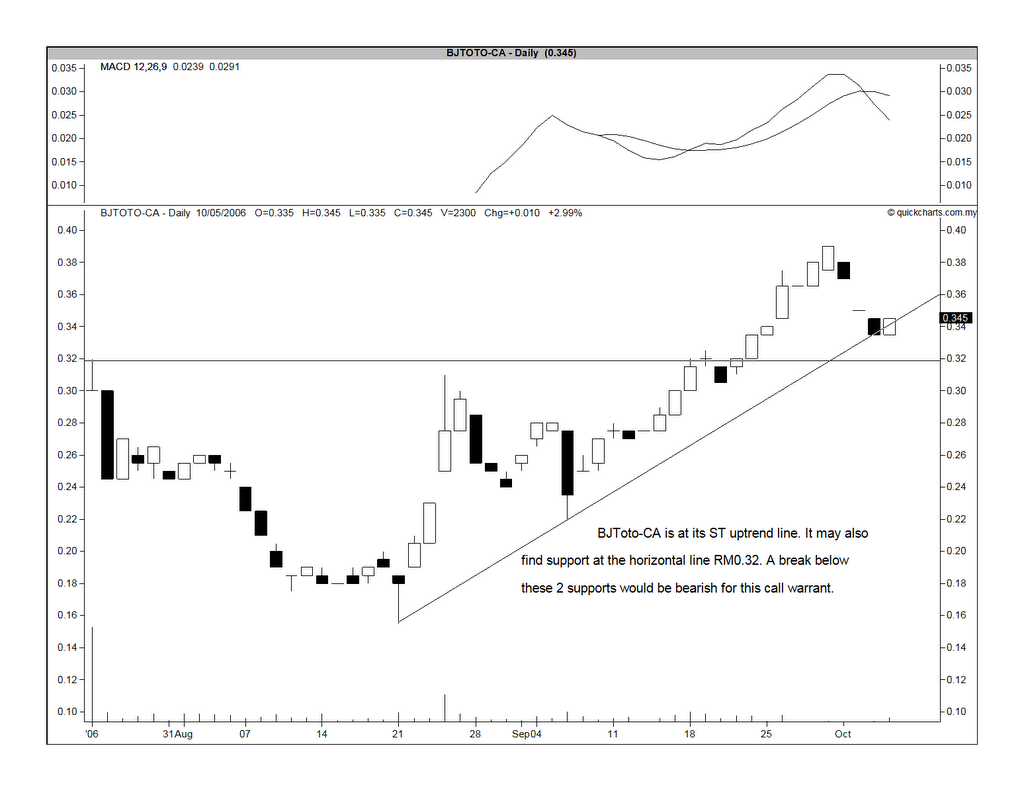
BJToto-CA has also declined in line with the drop in the price of the underlying share. It may test its short-term uptrend line at RM0.34. A break of that uptrend line may put it at the next support i.e. the horizontal line of RM0.32.


Chart 2: BJToto-CA's daily chart as at Oct 5


Conclusion

BJToto & BJToto-CA may be testing its uptrend line shortly. This may be a good buying opportunity as the share & call warrant would probably re-bound from the uptrend line. A break of the uptrend line would be bearish & in which case, you may want to exit your position until the technical outlook has recovered. This is a call based more on technical reasoning eventhough BJToto is a fairly attractive company, fundamentally.

Thursday, October 05, 2006

Gamuda is testing its short-term uptrend

Gamuda is testing its short-term uptrend line. At 4.00 p.m. today, Gamuda's share price was down 4 sen to RM3.90. The uptrend line support is at RM3.94. This means that it is marginally below the uptrend line. It needs to recover above RM3.94 over the next day or two, otherwise the short-term uptrend line is deemed broken. The consequence of this is that the share price may go down further. See the chart below.


Chart: Gamuda's daily chart as at Oct 4

Evergreen has broken above its medium-term downtrend

Background

Evergreen is involved in the manufacture of medium density fibreboard, knock-down furniture and doors.

Recent Financial Results

Evergreen's turnover for QE30/6/06 increased by 4.8% q-o-q or 19.4% y-o-y to RM129.6 mil. Pre-tax profit has jumped 42.2% q-o-q or 28.1% y-o-y to RM16.1 mil. Net profit has increased 29.9% q-o-q to RM14.1 mil but declined by 12.6% when compared to the same quarter last year. The latter decline was due to RM5.4 mil of prior years' over-provision of taxation reversed in QE30/6/05.


Valuation

Based on the EPS of 2.94 sen for QE30/6/06, Evergreen's full year EPS could be 11.8 sen. At yesterday's closing price of RM0.90, Evergreen is now trading at a PE of 7.6 times. While this may not look cheap, I expect Evergreen's performance to improve going forward. Its recent performance has been affected by stiff competition as a result of overexpansion in the industry & high operating cost (such as the cost of glue caused by high crude oil prices and sharp hike of the cost of rubber-wood).
Technical Outlook

Evergreen has just broken above its medium-term downtrend line at the RM0.90 level. With this, Evergreen's downside is limited. We will however have to wait for the uptrend to be established. See the chart below.


Chart: Evergreen's weekly chart as at Oct 4

Conclusion

Based on improving outlook, both on the technical & fundamental fronts, I believe that Evergreen will be a good long-term investment.

CI has just broken below its ST uptrend line

The CI has just broken below its short-term uptrend line at the 966 level while the daily MACD has also crossed down. This means that the market in the short-term is likely to enter a corrective phase (see Chart 1 below).


Chart 1: CI's daily chart as at Oct 4

In a correction, the CI may find support from the horizontal supports of 950 & 938. The next possible uptrend line, which commenced on Jun 15, will also provide support at the 940 level. See Chart 2 below.


Chart 2: CI's daily chart as at Oct 4

With this bearish outlook, I believe that investors & traders should be more careful in the market until the sign has changed.

Wednesday, October 04, 2006

Crude Oil has broken below its long-term uptrend line

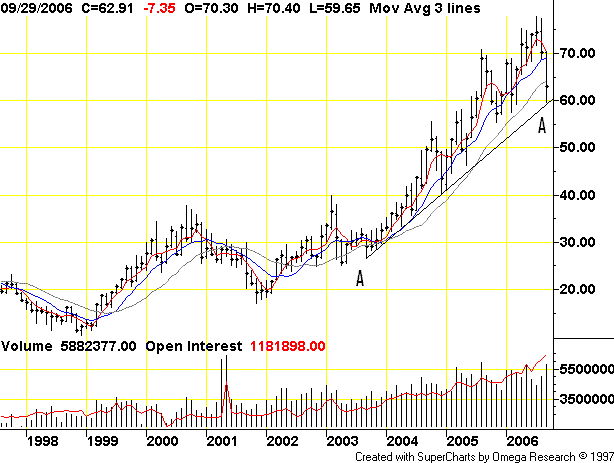
Crude oil has broken below its long-term uptrend line, which started in August 2003. The long-term uptrend line support is at the USD60.00 level. At 23.00 GMT, Crude oil is trading at USD58.40. At this level, it is about 2.7% below the long-term uptrend line and a swift recovery is necessary within the next day or two, failing which Crude oil's uptrend is over!!!


Chart 1: Crude oil's monthly chart as at September 29

From the above monthly chart, you can see the long-term uptrend line, which is denoted here as AA. The uptrend line was tested once in September and Crude oil re-bounded to USD63.80. But, the re-bounce could not sustain & yesterday, Crude oil broke through the uptrend line.

The signs were there that a severe test of the long-term uptrend line was about to come. From the weekly chart below, you can that the Bollinger Bands were diverging (area shaded blue & marked as ‘B’) instead of converging (area shaded yellow & marked as ‘A’). This means that the selling might not have exhausted yet.


Chart 2: Crude oil's weekly chart as at Oct 4 (overlaid with Bollinger Bands, Parabolic & Slow Stochastic)

We will have to wait & see how Crude oil perform over the next few days. A convincing break of the long-term uptrend line would certainly lead to benefits to the economy & the stock market. Nevertheless, we have to be watchful of surprises similar to the Amaranth blow-up because a lot of hedge funds had piled into the Crude oil rally in the past few months. A few disasters like Amaranth happening simultaneously could seriously affect the market. You may recall my comment sometime back about excess kurtosis or ‘fat tails', where destructive market events occur. Well, this scenario may play out here. Hopefully, not.

Note:

The Amaranth debacle happened when the hedge fund's heavy bets on Natural Gas went badly wrong. You can read about it here, here & here.

Tuesday, October 03, 2006

Resorts may have just tested the immediate uptrend line

Resorts dropped 30sen to RM10.80 at the close of this morning’s trading. It has declined to a low of RM10.60 in early trading before buying emerges. The weekly chart below shows that Resorts’ immediate uptrend line is likely to provide support at the RM10.50 level. If this support failed, the next supports will be the strong psychological support of RM10.00 & the support provided by the next uptrend line (of RM9.80). See the weekly chart below.


Chart: Resorts' weekly chart as at Oct 2

Resorts has recently announced its result for QE30/6/06. The turnover increased 9.0% q-o-q to RM899 mil while pre-tax profit jumped 28.8% q-o-q to RM257 mil. Net profit has however declined by 27.4% q-o-q to RM177 mil because Resorts had written back RM101 mil of over-provision in tax in respect of prior years in QE31/3/06, which resulted in a tax credit of RM43.8 mil. This compared with a tax charge of RM80.3 mil for the QE30/6/06.

Resorts’ turnover for QE30/6/06 is 2.5% lower than the turnover for QE30/6/05 because the latter includes an exceptional gain of RM113.3 mil from the disposal of London Casino International (which was taken in at the "turnover" level). This exceptional gain plus other gains totaling RM18.1 mil from other investments (the latter were taken in at the "pre-tax profit" level) has resulted in Resorts reporting a pre-tax profit of RM399 mil for QE30/6/05. As such, when we compared the pre-tax profit for QE30/6/06 with the pre-tax profit of QE30/6/05, we will see a 35.5%-drop. The net profit has similarly dropped 45.8% for the two periods. See the table below for Resorts' financial results for QE30/6/06, QE31/3/06 & QE30/6/05.


Based on the EPS of 16.18 sen for QE30/6/06, Resorts' annualized EPS will be about 64.72 sen. At this morning's closing price of RM10.80, Resorts is now trading at a PE of 16.7 times. Resorts' net profit has been depressed by its share of losses incurred by its associate, Star Cruise, which amounted to RM57.5 mil for QE30/6/06 and RM46.5 mil for QE31/3/06. If the performance of Star Cruise can improve over time, Resorts' EPS will also improve.

In conclusion, Resorts' current weakness may present a good buying opportunity. A good entry may be between RM10.00 and RM10.50.

CI- Can it break through the 970 resistance?

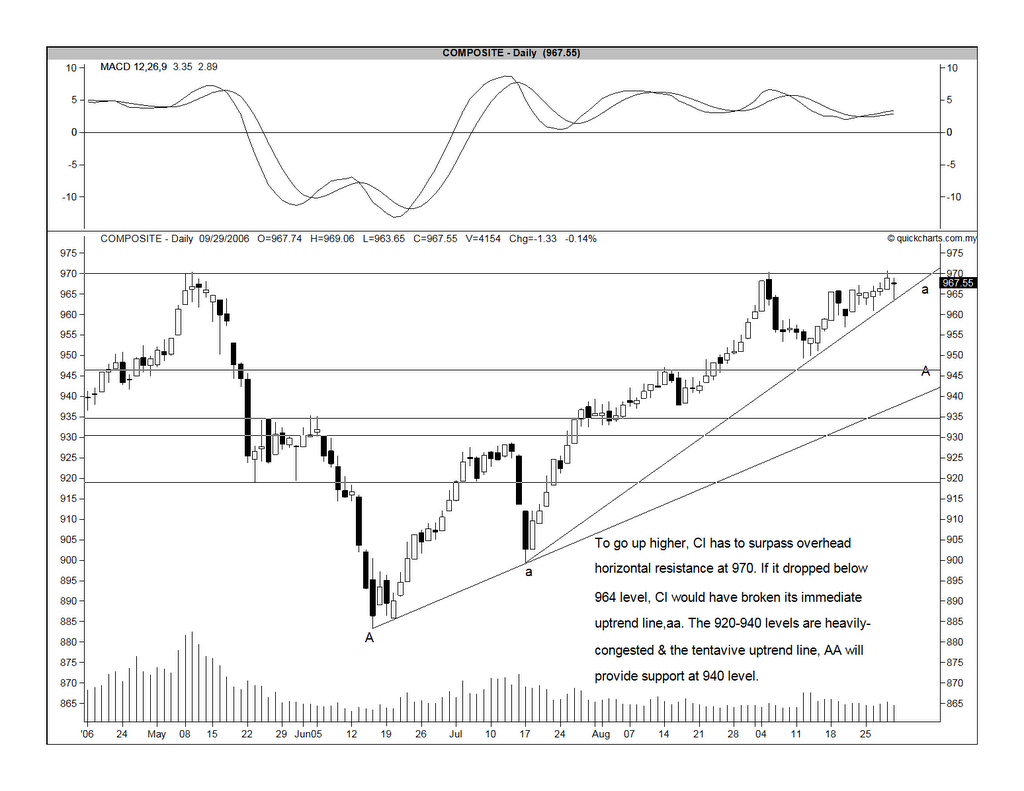
The CI has again come to the very strong horizontal resistance of 970. Its attempt at this level failed on Sep 28 and the market has retreated back to find support at the 964 level provided by the immediate uptrend line. A break above the 970 or below the 964 will determine the direction of the market going forward (see CI's daily chart below).


Chart: CI's daily chart as at Oct 2

Monday, October 02, 2006

Cenbond has a bullish breakout

Cenbond is involved in paper & plastic packaging. The company is planning to install a second production line for its stretchable film division, which is enjoying strong demand.

Based on the latest quarterly result for QE30/6/06, Cenbond has an annualized turnover of RM154 mil while achieving a net profit of RM9.2 mil. Its annualized EPS is about 7.7 sen. Based on its closing price of RM0.53 today, Cenbond is now trading at a PE of 6.9 times. See the table below.


Cenbond has announced a dividend of 3.5 sen, which will go "ex-div" on 17.10.2006. This is an improvement over last year's dividend of 2.5 sen. If the company can maintain this level of payout, then this stock is an attractive investment, yielding 7% return. This may be the catalyst that is currently boosting the share price.

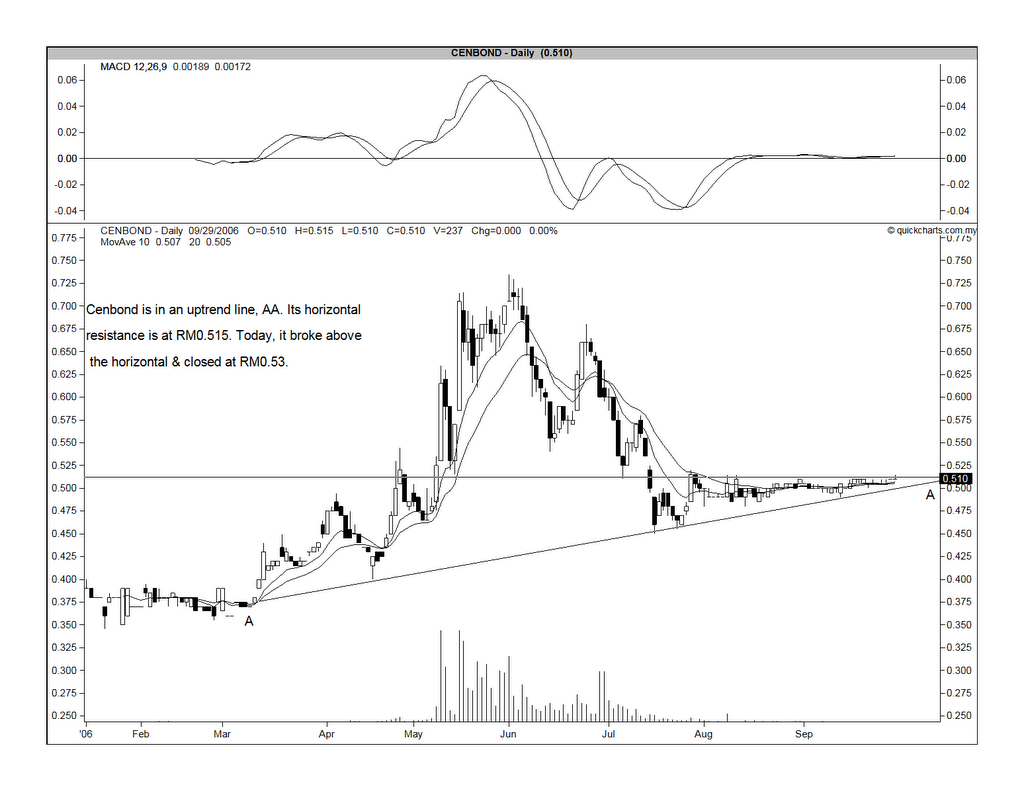
From the chart below, we can see that Cenbond is in a short-term uptrend line, with support at the RM0.50 level. Overhead resistance is at RM0.515, which was surpassed today. This may be a bullish move, which may see the share price going possibly to the RM0.58/0.60 level.


Chart: Cenbond's daily chart as at Sep 29

MEMS has pulled back to its ST uptrend

On August 14, I've posted a BUY call for MEMS, which had then broken out of an ascending triangle at the RM0.495/0.50 level. The share then rose to achieve a high of RM0.59 on Sep 19 before undergoing its current corrective phase.

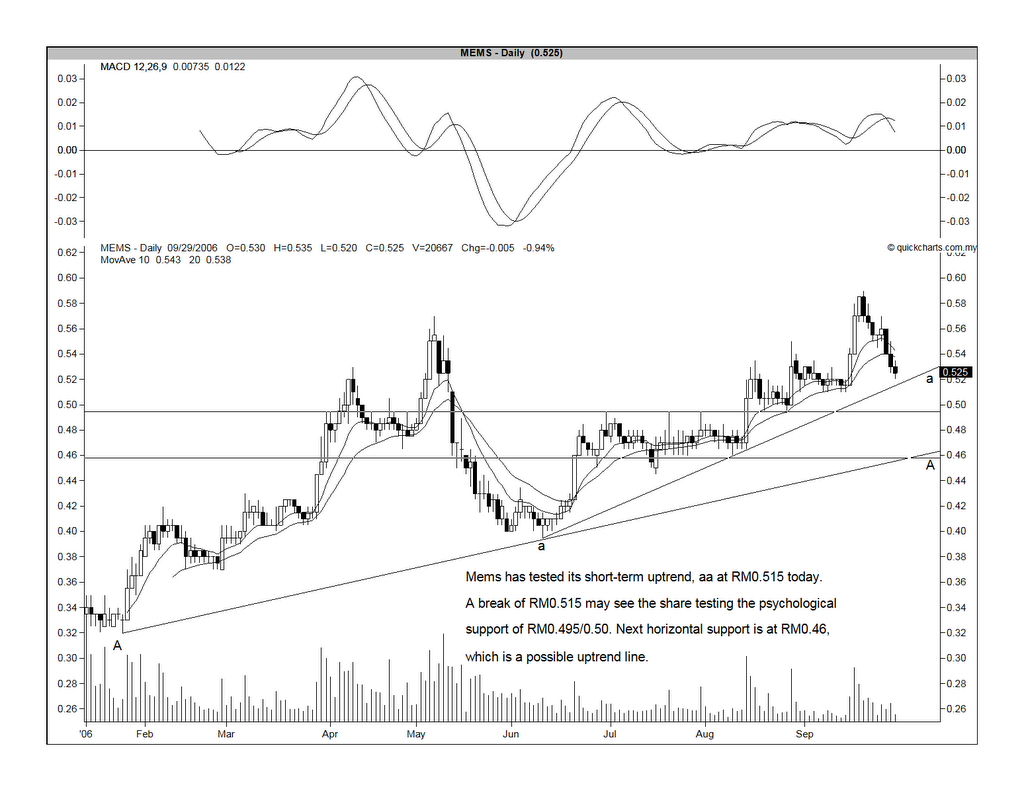
There is a good chance that this correction may end soon as the share may find support at the short-term uptrend line, which started in June this year. That support is near RM0.515. If this support fails, the share may go to the psychological support of RM0.50 or even the RM0.46 level, where we can see supports from both the horizontal line & the potential medium-term uptrend line (which starts from Jan this year). See the daily chart below.


Chart: MEMS' daily chart as at Sep 29


There were a number of reports stating that MEMS is likely to secure a substantial contract soon. This may have boosted its share price but, without any announcement being not made, the rally could not sustain. Recently announced results did not show any significant improvement in the company's topline nor bottomline that may justify the sudden surge in the share price. At an annualized EPS of 2.14 sen, MEMS (closed at RM0.515 today) is now trading at a PE of 24 times.


Nonetheless, the RM0.515 level may be a good entry level for a trade on this stock. The share may drop momentarily to RM0.50 and if it can recover back to the ST uptrend line, an entry established at around this level is acceptable.

Call Warrants- A few things to look out for

Call warrants are options issued by third parties which grant the holders the rights to acquire the underlying shares at a pre-determined exercise price. Most call warrants issued todate are cash-settled on maturity, which means that the holders do not have the rights to acquire the underlying shares from the issuer. Instead, the holders will receive a "profit" if the "closing price" of the underlying share on maturity date of the call warrant is higher than the exercise price of the call warrant.

Call warrant differs from ordinary warrant in the following manners:

1. It is issued by third parties (normally, an investment bank); and
2. It is normally cash-settled.

Its tenure is normally shorter than the usual tenure of 5 years for ordinary warrants. Some of the recent call warrants have tenure as short as 8 months (eg. BJToto-CA & Astro-CA). With such short tenure, call warrant's risk has increased significantly as the chances of it maturing "outside the money" have increased. Therefore, it is fair to say that call warrants are not for the risk averse investors. Nevertheless, call warrants cannot be ignored by the more sophisticated investors because of the leverage afforded for a given amount of funds. Leverage is however a double-edged sword; you may make higher return, but you may also make bigger losses.

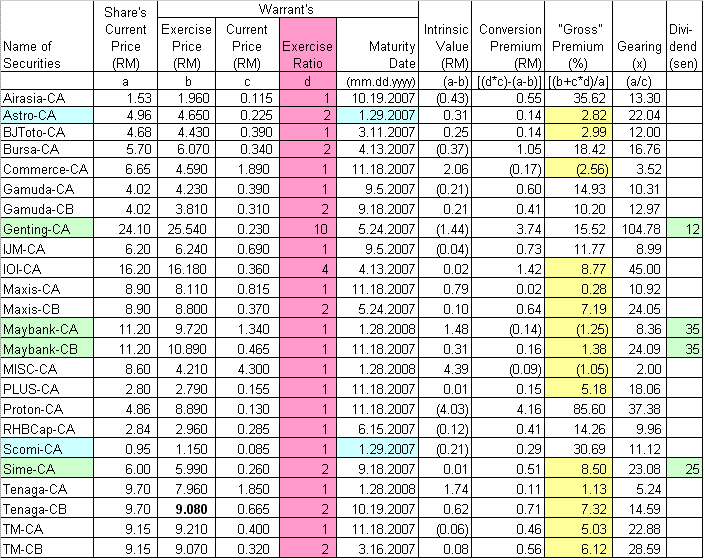
One of the reason why I track call warrants is that there are currently very few warrants issued by blue-chip companies. The only warrants that allow investors to benefit from a blue-chip rally are the call warrants (eg. Genting-CA; Maybank-CA & CB; Tenaga-CA & CB; TM-CA & CB etc). I've set up a spreadsheet for these call warrants & track them carefully (see the table below).


Table: Call Warrant Update as at September 29

You can obtain almost all the above information from the Star newspaper (Starbiz Saturday edition) as well as from the Edge newsletter. The reason why I wrote this post is that both these sources omitted something which is very crucial in the valuation of a warrant i.e. the exercise ratio. I have highlighted this in pink in the above table. The error is likely to be due to the fact that the Warrant Update of these 2 sources comprises ordinary warrants & call warrants; where, until recently, all the warrants' exercise ratio is 1 warrant "convertible" to 1 share. The recent call warrants were issued with differing exercise ratio such as 2-for-1 in the case of Astro-CA, Bursa-CA, Gamuda-CB, Maxis-CB, Sime-CA, Tenaga-CB & TM-CB; 4-for-1 for IOI-CA; and, 10-for-1 for Genting-CA. By ignoring the exercise ratio, Genting-CA would appear to have a premium of 6.9% whereas the correct premium should be 15.5%.

However, it must be stated that the above table only gives a very simplistic view of the "fair value" of call warrants because it does not take into account the tenure of the warrant & the dividend receivable by the underlying shares. A warrant with a longer tenure should command a higher value than one with a shorter tenure, ceteris paribus. And, a warrant of an underlying share that pays higher dividend should have a lower premium that one that pays lower dividend. Nevertheless, these 2 factors can be found in the above table [i.e. warrants with immediate dividend receivable are highlighted in green & warrants with less than 4 months' duration to expiry are highlighted in blue]. To account for these factors, one should use the Black Scholes method of option valuation.

Finally, the most important determinant of how much premium a call warrant may command is the direction of the price movement of the underlying share. If the underlying share is trending upward, the call warrant will be in big demand & this will naturally lead to a higher premium. On the other hand, if the underlying share is trending downward, the call warrant will be sold down & this will lead to a contraction in the premium (or, even trading at a discount).

In the above table, I have highlighted all the call warrants that trade at a reasonable premium [of less than 10%] in yellow. Before making a trade on any of these call warrants, you should satisfy yourself that the call warrants' remaining tenure is acceptable and that the underlying share's near-term potential is exciting.

Friday, September 29, 2006

The drop in Crude Oil has benefitted some

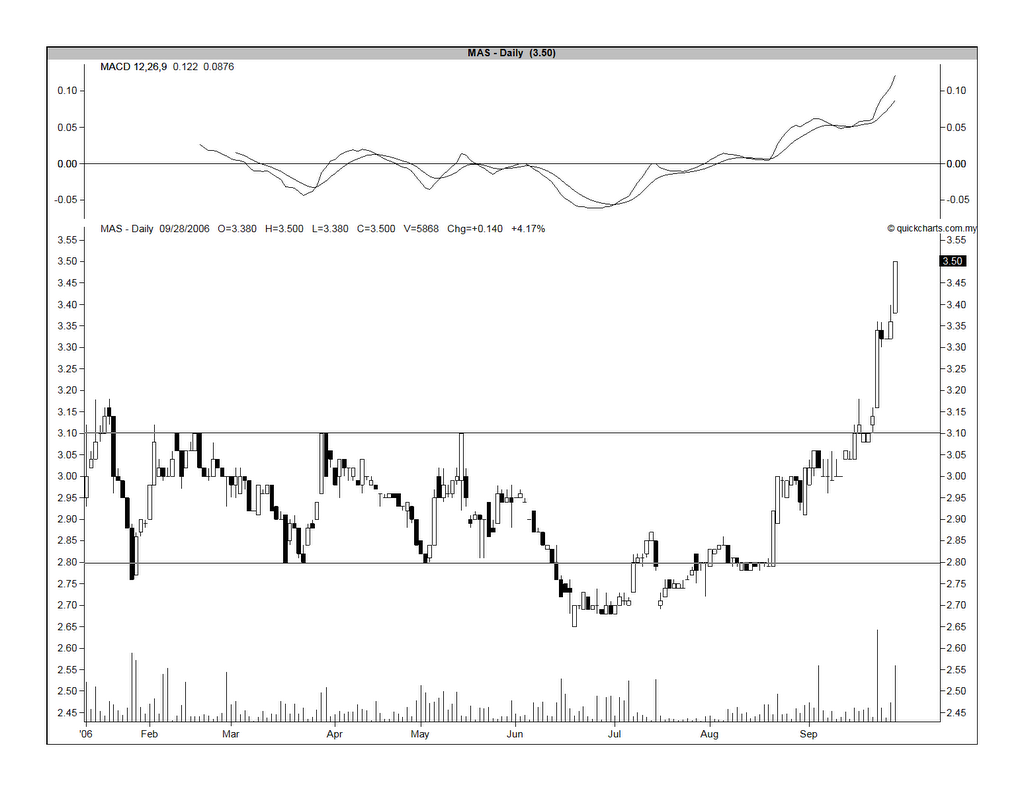
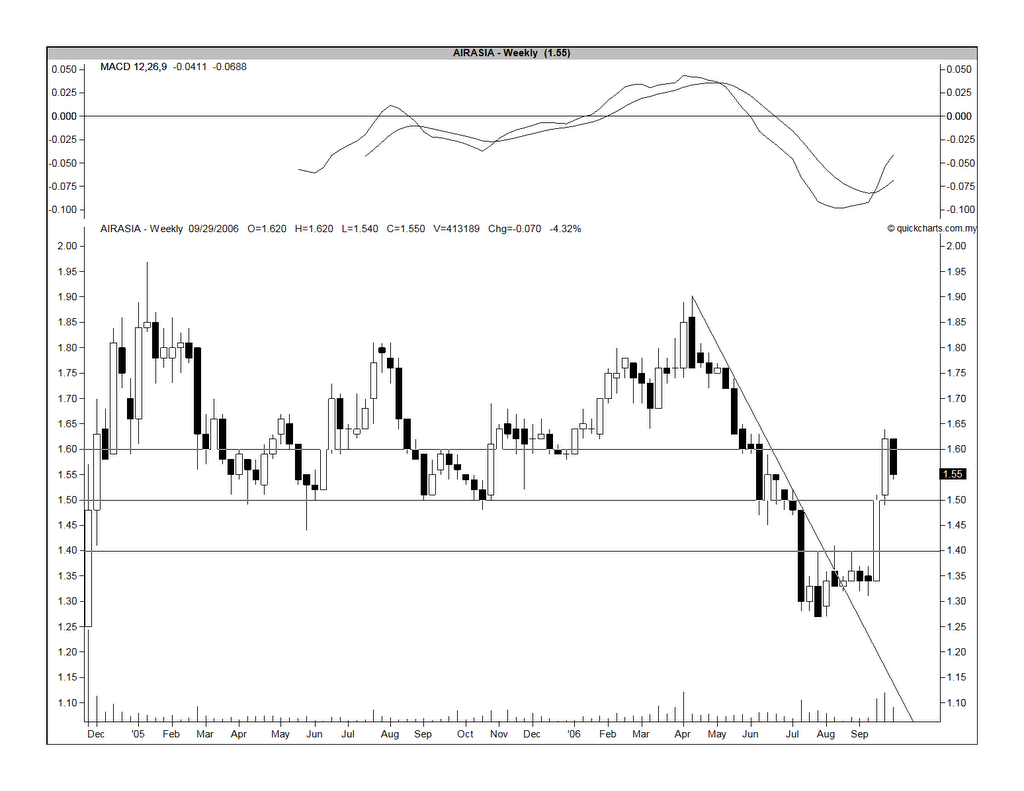
The drop in the price of Crude Oil has benefitted the airlines as well as other transportational stocks. Both airlines listed on Bursa i.e. MAS and Airasia have seen their share price recovering substantially in the past few days.

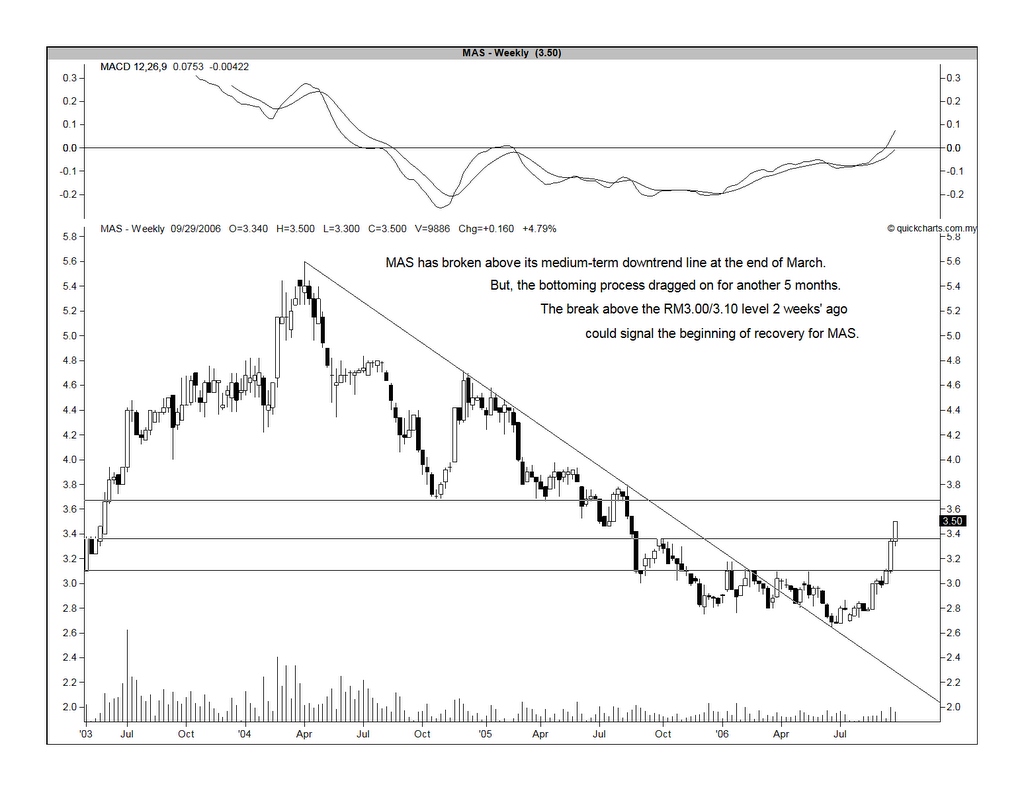
MAS, which was trading below RM3.00 at the end of August, has rallied to close at RM3.50 yesterday. From the weekly chart (Chart 1), we can see that MAS is likely to have commenced on its uptrend after breaking above the RM3.00/10 level.


Chart 1: MAS' weekly chart as at September 28


Chart 2: MAS' daily chart as at September 28

Airasia has similarly staged a strong rally, which saw the share price breaking out of its bottoming range between RM1.30-1.40, to reach a high of RM1.64 on September 22 (see Chart 3 & 4 below).


Chart 3: Airasia's daily chart as at September 28


Chart 4: Airasia's weekly chart as at September 28


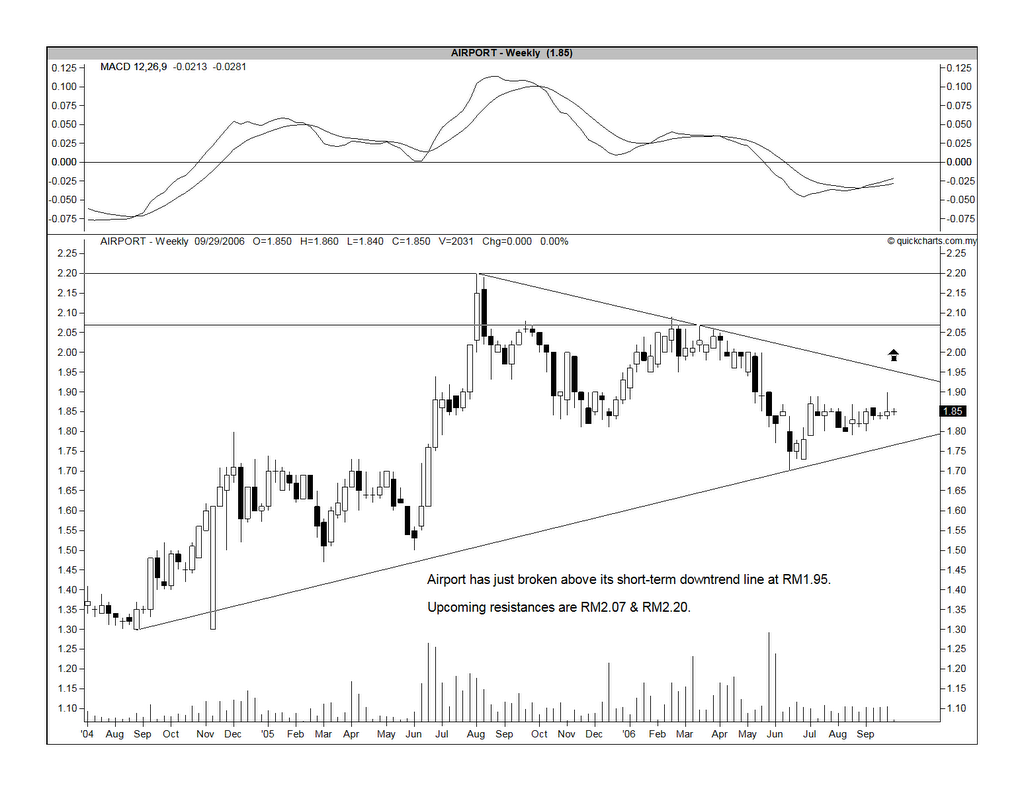
Airport has also recovered although at a more subdue pace. Its share price has jumped 16 sen to RM2.01 as at 4.00 p.m. today (see Chart 5 below).


Chart 5: Airport's weekly chart as at September 28

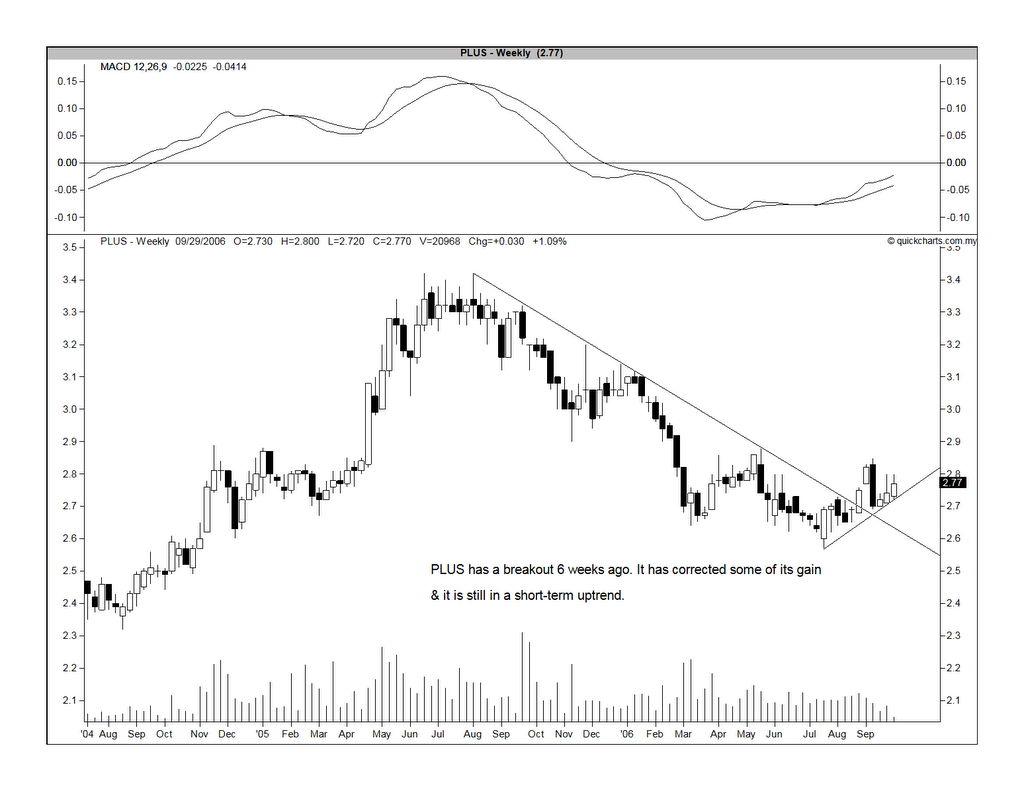
Finally, PLUS- which has suffered a drop in the growth rate of its traffic volume because of higher gasoline prices- has also seen its share price recovering.


Chart 6: PLUS' weekly chart as at September 28